
What Is an AI Sales Assistant?
Discover how an AI sales assistant transforms your sales process. Learn to automate tasks, qualify leads, and boost revenue with this complete guide.
Let's get right to it. What exactly is an AI sales assistant?
Think of it less like a robot and more like the most efficient team member you've ever had. It's a smart software tool that takes on the repetitive, administrative grunt work of sales. It works around the clock, logging every interaction and making sure no lead ever slips through the cracks, so your human team can focus on what they do best: building relationships and closing deals.
Why Do Sales Teams Even Need an AI Assistant?

Here’s a frustrating reality for most sales leaders: your best reps are likely spending almost two-thirds of their day on tasks that have nothing to do with selling. It’s true. They get bogged down updating the CRM, logging calls, drafting follow-up emails, and scheduling meetings. These jobs are necessary, but they drain time and energy that should be spent talking to prospects.
This is precisely where an AI sales assistant steps in. It's a force multiplier for your team, automating the manual, time-sucking processes that cause burnout and kill momentum. By taking over these workflows, it frees your people to operate at their peak, concentrating on the high-impact activities that actually drive revenue.
Shifting the Focus from Admin to Action
Today's sales world is brutally competitive. Success hinges on speed, personalization, and persistence. But manual processes are like anchors, slowing everything down and creating bottlenecks in your sales cycle. An AI assistant cuts those ropes, making your entire operation faster and more responsive.
Instead of dreading hours of data entry, your reps can simply trust their AI partner to handle it instantly and without error. This isn't about replacing people; it's about making them better. The idea is to create a powerful partnership where technology handles the tedious work, and your team masters the nuanced art of negotiation and building real human connections.
"The true value of an AI sales assistant is its ability to give your best people their time back. It's not just about efficiency; it's about reallocating your most precious resource-human expertise-to where it matters most: closing deals."
What This Guide Will Cover
We're going to cut through the buzzwords and get straight to what AI sales assistants can actually do for you. My goal is to give you a practical understanding of how this technology works and the tangible results it can bring to your business.
Here's what we'll dig into:
- Core Capabilities: What specific, day-to-day tasks can an AI assistant realistically take off your team's plate?
- Business Benefits: How does it tangibly improve productivity, lead quality, and the customer experience?
- Implementation Steps: A straightforward roadmap for getting an AI assistant up and running with your team.
- Measuring ROI: Which key metrics will prove the financial impact of your investment?
- Real-World Examples: We’ll look at how tools like Whisperchat.ai are already solving these common sales challenges.
What an AI Sales Assistant Actually Does
To really get what an AI sales assistant brings to the table, we need to look past the buzzwords and see what it does day-to-day. This isn't just about making things faster; it's about changing the very rhythm of your sales team's work. Think of it as a highly skilled specialist that handles four critical jobs, freeing up your people to do what they do best.
The AI essentially wears four hats: it's your lead qualifier, your outreach expert, your 24/7 chat guide, and your perfect CRM clerk. By taking on these roles, it lets your sales reps drop the administrative juggling act and focus entirely on building relationships and closing deals. It's no wonder the market for these tools is exploding.
The global AI sales assistant software market was valued at over USD 2.9 billion in 2025 and is expected to climb to around USD 20.5 billion by 2035. That's a huge shift, showing just how many businesses are rethinking their sales process.
Your Tireless Lead Qualification Specialist
Picture this: a hot lead lands on your website at 10 PM on a Tuesday. With a traditional setup, that lead goes cold overnight. But an AI sales assistant jumps on it instantly.
It immediately scans the lead's details, scores their potential based on criteria you set (like company size or website behavior), and can even ask a few qualifying questions in a completely natural way. The best leads get a meeting booked on a rep's calendar right away, while others are placed into a nurturing sequence. No more missed opportunities.
Your Automated Outreach Machine
We all know how much time gets sunk into writing follow-up emails and scheduling outreach. The AI assistant takes that entire burden off your team's shoulders.
It can trigger personalized email campaigns based on where a lead is in your CRM, send perfectly timed reminders, and automatically stop the sequence the moment someone replies or books a call. This means every lead gets persistent, timely follow-up without anyone having to lift a finger.
Your 24/7 Chat-Based Nurturer
Potential customers have questions at all hours, and they don't like to wait. An AI-powered chatbot on your site acts as your always-on front line.
It can handle common questions about products and pricing, point visitors to the right resources, and, most importantly, spot buying signals in the conversation. Some businesses even use specific tools like an AI Call Assistant form to directly capture and qualify interest from these interactions.
This instant, helpful engagement dramatically improves the customer experience. Instead of waiting for a response, potential buyers get the information they need the moment they ask for it, building trust and momentum from the very first interaction.
Your Flawless CRM Data Entry Clerk
If there's one task every sales rep hates, it's manual CRM updates. It’s boring, easy to mess up, and a major distraction from actually selling. An AI assistant makes this problem disappear.
It automatically logs every call, email, and meeting. It updates contact records with new information and ensures the pipeline is always a perfect reflection of reality. This means you get clean, reliable data for forecasting, and your reps get more time to sell.
To see the difference in action, let's compare the old way with the new.
Manual Sales Tasks vs AI Sales Assistant Automation
| Manual Sales Task | How an AI Sales Assistant Automates It |
|---|---|
| Manually sifting through new leads | Instantly scores and qualifies leads 24/7 based on your ideal customer profile. |
| Writing and sending individual follow-up emails | Deploys personalized, multi-step email and SMS campaigns automatically. |
| Answering repetitive questions from website visitors | Provides instant, accurate answers to common questions via a website chatbot. |
| Forgetting to update the CRM after a call | Automatically logs all activities, calls, and meeting notes under the correct contact. |
| Guessing which leads to prioritize | Uses data to identify and surface the highest-intent leads for immediate follow-up. |
This side-by-side view makes it clear: the AI isn't just a helper; it's a system for eliminating manual work and ensuring nothing ever falls through the cracks.
The infographic below really drives home the impact an AI sales assistant can have on the numbers that matter most.
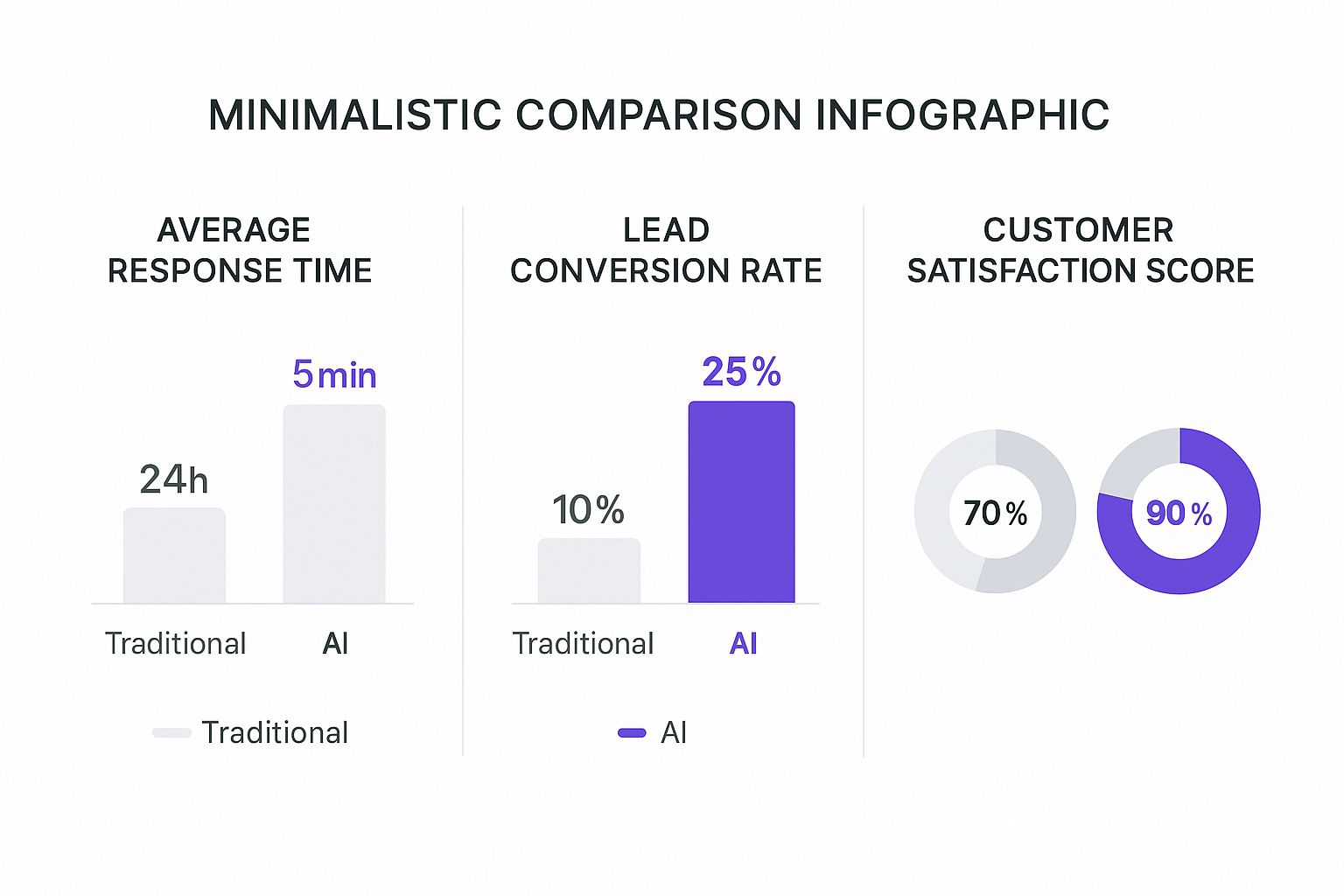
As you can see, this kind of automation leads directly to faster responses, more closed deals, and a much happier customer base.
The Real-World Business Impact of Using AI in Sales
It’s one thing to understand the what of an AI sales assistant, but what really matters is seeing the impact on your bottom line. We're not just talking about simple automation here. This technology delivers strategic value that can ripple across your entire sales operation, fundamentally changing how your team operates for the better.
The true value of an AI sales assistant lies in its ability to turn raw effort into tangible results. It tackles four key areas that directly drive revenue: boosting team productivity, improving lead quality, enhancing the customer experience, and paving the way for smarter, data-driven decisions. Each of these pillars helps build a more efficient, effective, and profitable sales engine.
Send Sales Productivity Through the Roof
Picture your best sales rep. Now, imagine them spending nearly 10 hours a week on administrative tasks-updating the CRM, logging calls, scheduling meetings. It's necessary work, but it's time they aren't spending actually selling. An AI sales assistant steps in here and acts as a genuine force multiplier.
By taking over all that repetitive data entry and scheduling, the assistant literally gives those 10 hours back to your rep. With that time back in their pocket, they can focus on what they do best: building relationships and closing deals. This renewed focus could easily lead to closing two extra deals a month, drawing a straight line from automation to revenue.
Sharpen Lead Quality and Prioritization
Let's be honest: not all leads are created equal. Your team's valuable time should be spent on prospects who are actually ready to talk business. Think of an AI assistant as an intelligent gatekeeper, analyzing every incoming lead against your ideal customer profile in real time.
It scores leads based on company data, user behavior, and engagement, making sure your reps only spend their time on the most promising opportunities. This intelligent filtering means less time wasted on dead-end conversations and a much higher conversion rate for the leads that make it through. The result? A cleaner, more valuable pipeline from day one.
By automatically separating high-intent buyers from early-stage researchers, an AI sales assistant ensures your team’s efforts are always focused where they will have the greatest impact, dramatically improving sales cycle velocity.
Elevate the Customer Experience
In today’s market, speed and personalization are non-negotiable. A potential customer who has to wait hours-or even minutes-for a response is probably already talking to your competitor. An AI sales assistant offers instant, 24/7 engagement, answering common questions and qualifying leads the second they show interest.
This immediate, helpful interaction creates a smooth customer journey from the very first click. It ensures no opportunity slips through the cracks due to a simple delay and starts building trust right away.
Empower Smarter Sales Decisions
Finally, an AI assistant gives you the clean, structured data you need for accurate forecasting and smart strategic planning. By automatically logging every single interaction, it gets rid of human error and makes your CRM a reliable source of truth.
This high-quality data allows sales leaders to:
- Forecast with Confidence: Predict future revenue based on a complete and accurate picture of the sales pipeline.
- Identify Winning Patterns: Analyze what’s actually working in sales calls and replicate those successful strategies across the entire team.
- Optimize Sales Processes: Pinpoint bottlenecks and inefficiencies in the sales cycle that would otherwise fly under the radar.
This level of insight helps your team move from being reactive to being truly proactive. If you want to dive deeper into this, you can learn more about creating a powerful AI agent for sales in our related guide.
How to Bring an AI Sales Assistant on Board
Bringing an AI sales assistant into your team isn't as simple as flipping a switch. It's more like hiring a new, highly-efficient team member. You need a solid game plan to define their role, integrate them with the crew, and set them up to win.
When done right, a successful rollout can genuinely transform your sales process, boost morale, and drive serious revenue. The good news? Modern tools are built for a smooth transition. A study from AWS even found that sellers using a generative AI sales tool saw a 4.9% increase in the value of the opportunities they created. That’s the kind of impact you can expect when you get the implementation right from day one.
Here’s a clear, step-by-step roadmap to guide you through the process, from figuring out what you need to measuring its impact down the line.
Step 1: Define Your Goals and Scope
Before you even glance at a single demo, you need to answer one crucial question: What specific problem are you actually trying to solve? Vague goals like "improving efficiency" just won't cut it. You have to get specific.
Are your reps drowning in manual CRM updates? Is your lead response time so slow that you're losing deals before they even start? Maybe you're struggling to qualify a massive influx of inbound leads. Pinpointing your primary pain points is the most critical first step.
Your goals need to be concrete and measurable. For instance:
- Slash Lead Response Time: Get the average time to first contact down from 4 hours to under 5 minutes.
- Give Reps More Selling Time: Free up at least 8 hours per sales rep each week by automating tedious admin work.
- Sharpen Lead Qualification: Boost the rate of sales-qualified leads (SQLs) by 25% in the first quarter.
With clear goals like these, you'll know exactly which features you need in an AI sales assistant. This prevents you from overpaying for a bloated tool packed with capabilities you'll never touch.
Step 2: Choose the Right AI Sales Assistant
Once you know what you need, you can start exploring your options. The market is crowded, but the right tool for you will feel like it was built just for your team, aligning perfectly with your goals and existing tech.
As you evaluate different platforms, focus on these non-negotiables:
Seamless CRM Integration: This is an absolute deal-breaker. The assistant must be able to read and write data to your CRM-whether it's Salesforce, HubSpot, or Odoo-without any friction. If it can't log activities and update records automatically, it's just creating more work.
Ease of Use: The interface has to be intuitive for everyone, from sales leaders to the reps on the ground. If a tool is clunky or requires a mini-degree to operate, your team simply won't use it. Look for no-code platforms with user-friendly dashboards, like the ones we've built at Whisperchat.ai.
Customization and Scalability: Your business isn't static, and your tools shouldn't be either. Can you easily tweak its scripts, qualification rules, and workflows as your strategy evolves? More importantly, can the platform handle a bigger workload as your lead volume grows?
The best AI sales assistant is one that feels like a natural extension of your team. It should simplify workflows, not complicate them, and provide clear, actionable data that helps everyone perform better.
Step 3: Integrate with Your Existing Tech Stack
A smooth implementation all comes down to how well the new tool plugs into your current systems. And this goes way beyond just the CRM. Think about your email platforms like Gmail or Outlook, your calendar apps, and your team's communication hub, like Slack.
The aim here is to create a fully connected ecosystem where information flows automatically. For example, when the AI assistant books a meeting, that event should instantly pop up on the rep's calendar, update the lead's status in the CRM, and maybe even ping a dedicated Slack channel. This kind of deep integration eliminates manual data entry and ensures everyone is on the same page, all the time.
If you're looking for practical ways to generate leads through these kinds of automated conversations, our guide on chatbot lead generation is packed with actionable strategies.
Step 4: Train Your Team and Drive Adoption
A new tool is only as good as the people who use it. You have to introduce the AI sales assistant not as a replacement, but as a powerful partner designed to make their jobs easier and, frankly, more profitable.
Start by clearly explaining the "why" behind the change, connecting the tool directly to the pain points you identified back in step one. Show them exactly how it will help them close more deals and hit their commission targets.
Run some hands-on training sessions and create simple cheat sheets or video tutorials they can refer back to. And here’s a pro tip: identify a few "champions" on the team who are excited about the new tech. They can help evangelize the tool and support their peers, making adoption feel more organic and less like a top-down mandate.
Measuring the ROI of Your AI Sales Assistant
Bringing an AI sales assistant into your workflow is a significant business decision, and like any investment, it needs to prove its worth. It’s not enough to say things "feel more efficient." Your stakeholders, and frankly, your budget, will demand hard numbers.
This means we have to connect the dots between the tool's daily actions and the bottom line. Calculating the return on investment (ROI) isn't just a box-ticking exercise; it’s how you uncover the true financial impact your new AI teammate is making. When you track the right metrics, you can build a rock-solid case showing exactly how this technology drives revenue and cuts costs.
Key Performance Indicators to Track
So, where do you start? The trick is to zero in on a handful of metrics that an AI sales assistant directly impacts. Think of it as creating a "before and after" picture of your sales operation, making the tool's value impossible to ignore.
Here are the most critical metrics to keep your eyes on:
- Increase in Lead Conversion Rate: This is the big one. What percentage of your leads are actually turning into qualified opportunities? An AI's ability to respond instantly and follow up relentlessly can give this number a serious lift.
- Reduction in Sales Cycle Length: How long does it take to get a lead from that first "hello" to a signed contract? By automating tedious steps like scheduling and initial qualification, an AI can dramatically shorten this timeline.
- Increase in Sales Team Productivity: You need to quantify the time your reps get back. If each salesperson reclaims five hours a week from administrative drudgery, that’s five more hours they can spend actually selling.
- Cost Per Lead Reduction: Your AI handles the initial outreach and qualification that a human would otherwise have to do. This directly lowers the cost of acquiring and vetting every single lead that comes through your pipeline.
These are the numbers that tell the real story. Establish your baseline before you flip the switch on your AI, then watch how these metrics evolve over the next few months.
The whole point is to draw a straight line from the AI's work-like 24/7 lead engagement or automated CRM updates-to a positive swing in your most important sales numbers. You'll go from saying "it feels like we're more efficient" to "we closed 15% more deals this quarter because of it."
How to Calculate Your ROI
Once you’ve got the data, the math is surprisingly simple. The classic ROI formula works perfectly here: (Gain from Investment - Cost of Investment) / Cost of Investment.
Let's run a quick example. Say the AI assistant costs your company $1,000 a month. In that same period, it helped your team close five extra deals, each worth $2,000. That’s $10,000 in new revenue directly tied to the tool. The ROI in that scenario is massive, painting a very clear picture of a financial win.
It's this kind of demonstrable value that's causing the AI assistant market to explode. Valued at USD 3.35 billion in 2025, the market is expected to surge to USD 21.11 billion by 2030, according to data from MarketsandMarkets.com. Why? Because these tools deliver.
A Clear Framework for ROI Metrics
To help you get started, this table breaks down exactly what to measure, what it means, and how your AI sales assistant moves the needle.
Key Metrics for Measuring AI Sales Assistant ROI
This table outlines the essential performance indicators for evaluating the impact of an AI sales assistant. It provides a clear framework for connecting the tool's features to tangible business outcomes, helping you build a compelling case for its value.
| Metric | What It Measures | How the AI Assistant Influences It |
|---|---|---|
| Lead Conversion Rate | The percentage of leads that become customers. | Provides instant 24/7 responses and consistent follow-up, preventing lead drop-off. |
| Sales Cycle Length | The average time from first contact to closed deal. | Automates meeting scheduling and qualification, accelerating the sales process. |
| Sales Team Productivity | Time reps spend on active selling vs. admin tasks. | Eliminates manual data entry and CRM updates, freeing up hours for revenue-generating activities. |
| Customer Acquisition Cost (CAC) | The total cost to acquire a new customer. | Reduces manual labor costs associated with lead nurturing and initial outreach. |
Ultimately, a powerful ROI is built on two pillars: generating more revenue and creating operational savings. If you want to dive deeper into the savings aspect, especially in customer-facing roles, our guide on customer support automation is a great next step.
See AI Sales Assistants in Action with Whisperchat
It’s one thing to talk about the theory, but what does an AI sales assistant actually do for a sales team on a Tuesday afternoon? Let's make this real. We'll walk through how a tool like Whisperchat.ai tackles the everyday headaches that drain your team's time and lose you deals. This isn't about a list of features; it's about solving real problems.
Think about turning your website from a passive, digital brochure into your top-performing lead generator. That’s where you’ll see the first, most powerful impact.
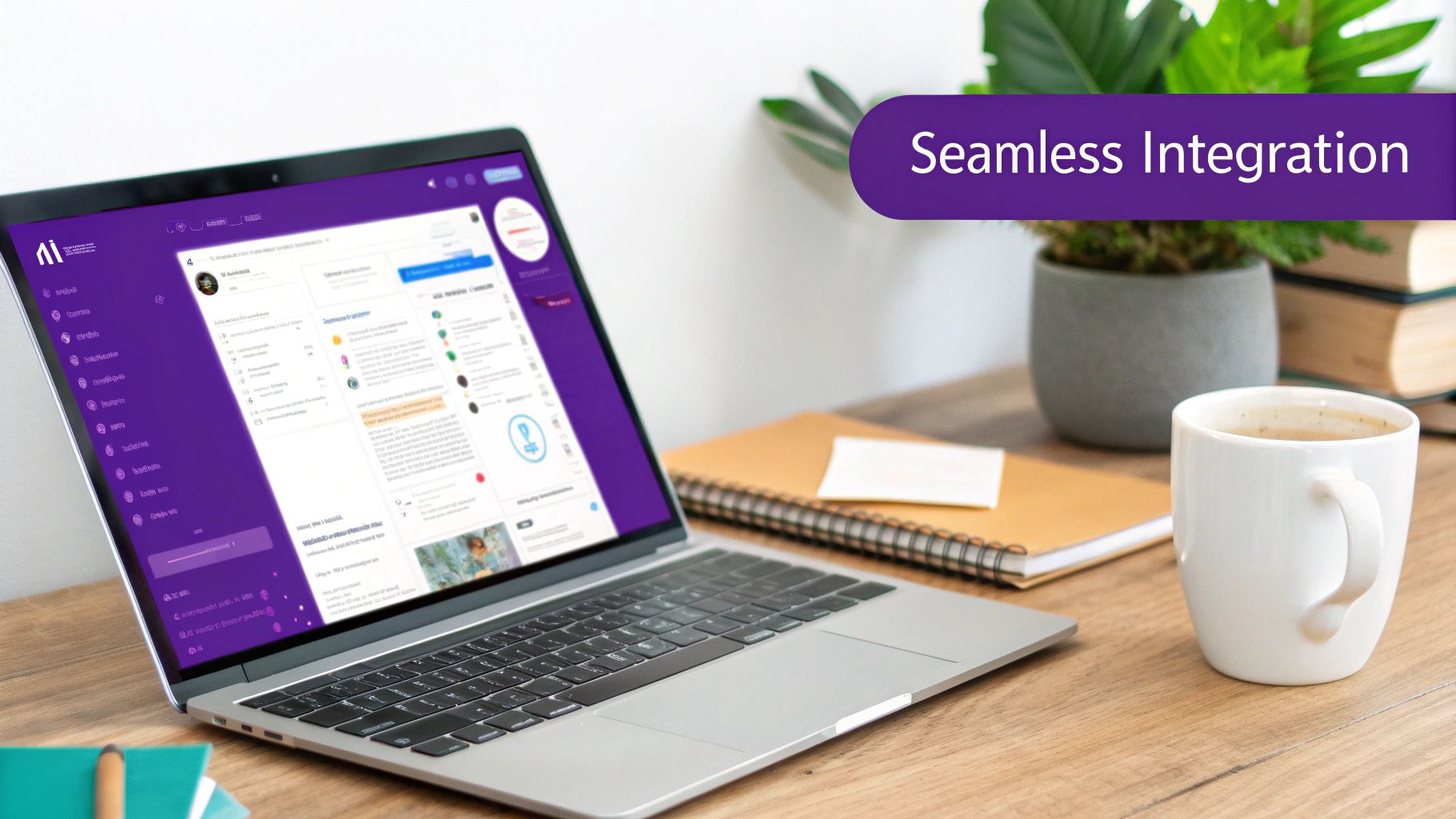
The image below gives you a peek inside the Whisperchat.ai dashboard. This is where you feed the AI your own business data, teaching it everything it needs to know.
This clean, simple interface is your mission control. It's where you build an AI assistant that understands your products, your pricing, and exactly what makes a great customer for your business.
From Anonymous Visitor to Qualified Lead
Every sales team knows this painful story. A potential customer lands on your site at 10 PM, ready to learn more. They’re interested, but their only option is a "Contact Us" form. They fill it out and wait. By the next morning, their initial excitement is gone, and they've probably already chatted with one of your competitors.
Whisperchat.ai flips this scenario on its head. It deploys a smart chatbot that's ready to engage visitors the moment they arrive.
- The Problem: High-intent visitors come to your site, can't get instant answers, and simply leave.
- The Solution: An AI chatbot greets them, answers their questions about pricing or features, and listens for buying signals.
- The Outcome: The bot captures their contact info and asks the qualifying questions you've set up. That anonymous visitor is now a hot, qualified lead waiting for your sales team first thing in the morning.
Nurturing Prospects with Personalized Automation
Another huge time-drain? Manual follow-up. Reps can easily lose hours every week writing nurturing emails for leads who aren't quite ready to pull the trigger. Too often, these are generic messages that just don't connect.
An AI sales assistant handles all of this automatically, but with a surprisingly human touch. It can launch personalized, multi-step email campaigns based on a lead's specific behavior, making sure the follow-up is persistent and, more importantly, relevant. All without a rep lifting a finger.
Eliminating the Scheduling Back-and-Forth
Finally, let's talk about the endless email tag required to book a single meeting. You know the drill: "How about Tuesday at 2 PM?" "Sorry, I'm booked. Does Thursday at 10 AM work?" This kind of friction doesn't just waste time; it kills momentum and frustrates everyone involved.
A good AI sales assistant connects directly to your team's calendars. As soon as the bot qualifies a lead, it can offer up available meeting slots and book the demo right then and there. This one simple step gets rid of a major bottleneck, speeds up the sales cycle, and gives your future customer a smooth, professional experience from the very first touchpoint.
Got Questions? We’ve Got Answers.
Jumping into any new tech, especially something as smart as an AI sales assistant, is bound to bring up some questions. It’s completely normal. Let’s tackle the most common ones we hear from business leaders so you can feel confident about what this technology really means for your team.
Are You Saying an AI Assistant Will Replace My Sales Team?
This is easily the number one concern, and let me put it to rest: absolutely not. An AI sales assistant isn't here to take anyone's job. It’s here to make their jobs better.
Think of it as the ultimate sidekick for your reps. It takes on all the tedious, time-sucking tasks that they secretly hate but have to do-things like manually updating the CRM, scoring leads, and juggling schedules. By automating all that administrative noise, the AI frees up your sales pros to do what humans do best: build real relationships, solve tricky customer problems, and, ultimately, close bigger deals.
The point isn't replacement; it's augmentation. An AI gives your best people back their most precious asset-time.
What’s the Price Tag on Something Like This?
The cost can vary, but the good news is you’re not looking at a massive upfront investment. Most modern platforms, including ours, operate on a subscription model, which makes it much more accessible.
What you pay usually depends on a few things:
- Your team size: How many salespeople will be using it?
- The features you need: A basic plan for simple automation will cost less than a premium one with deep analytics and complex integrations.
- How much you use it: Some pricing is tied to volume, like the number of leads it processes or emails it sends each month.
For most small and medium-sized businesses, entry-level plans are surprisingly affordable. They're specifically designed to pay for themselves quickly through boosts in productivity and higher conversion rates.
How Much of a Headache Is It to Integrate with Our CRM?
Developers know that if the tool doesn't play nicely with your existing systems, you won't use it. That's why today’s AI sales assistants are built to connect smoothly with major CRMs like Salesforce, HubSpot, and Odoo.
The setup is usually a breeze. We're talking a few clicks to authorize the connection, not a months-long IT project. Once it’s linked, the AI automatically syncs data back and forth, keeping your CRM perfectly up-to-date without anyone having to lift a finger. This means you get a smooth rollout and start seeing the benefits almost immediately.
Ready to see what an AI assistant could do for your sales process? With Whisperchat.ai, you can build and launch a smart chatbot trained on your own business data in just a few minutes. Start automating lead qualification and giving customers 24/7 support right away. Get started with Whisperchat.ai.