
Chatbot Lead Generation That Actually Converts
Unlock growth with our guide to chatbot lead generation. Learn to design, deploy, and optimize chatbots that capture and qualify leads 24/7.
Let's face it, the traditional "contact us" form is where visitor engagement goes to die. It’s a one-way street: a potential customer fills out a few boxes, clicks submit, and then... crickets. This old-school method is passive, creates a ton of friction, and often leaves your hottest leads waiting hours, or even days, for a response.
By the time you get back to them, their initial interest has likely cooled.
This is exactly where a well-implemented chatbot completely changes the game. Instead of making visitors do all the work, a bot greets them the second they arrive, ready to help and guide them. This immediate, two-way conversation is the key to capturing someone's attention when it's at its peak.
Chatbots vs Traditional Lead Forms
To really understand the difference, let's break down how these two approaches stack up against each other. One is a passive data collector, while the other is an active conversation starter.
| Feature | Traditional Lead Form | Chatbot Lead Generation |
|---|---|---|
| User Interaction | Passive, one-way data entry | Active, two-way conversation |
| Response Time | Delayed (hours or days) | Instant, 24/7 |
| Lead Qualification | None; manual follow-up required | Real-time, automated based on responses |
| Personalization | Generic, one-size-fits-all fields | Dynamic, adapts to user needs and questions |
| User Experience | Impersonal and often a chore | Engaging and helpful |
| Data Quality | Can be low or incomplete | Higher quality, verified in conversation |
As you can see, the chatbot's ability to engage, qualify, and personalize the experience in real-time offers a massive advantage. It transforms a frustrating chore into a genuinely helpful interaction.
Turning Passive Data Entry into Active Qualification
The fundamental shift is moving from simply collecting data to actually starting a conversation. This is so powerful because a chatbot can:
- Engage Instantly: It provides immediate answers and assistance, preventing visitors from bouncing off your site to look for a quicker solution elsewhere.
- Qualify in Real-Time: Through a series of natural questions, the bot can figure out if a visitor is a good fit. It can ask about their needs, their budget, and where they are in the buying process.
- Create Personalized Journeys: Based on the user's answers, the chatbot can intelligently route them to the most relevant blog post, case study, or even connect them directly with the right person on your sales team.
This is all happening automatically, around the clock, ensuring you never miss a potential lead. AI-powered bots are on duty 24/7, actively talking with visitors and gathering critical details long after your team has gone home for the day.
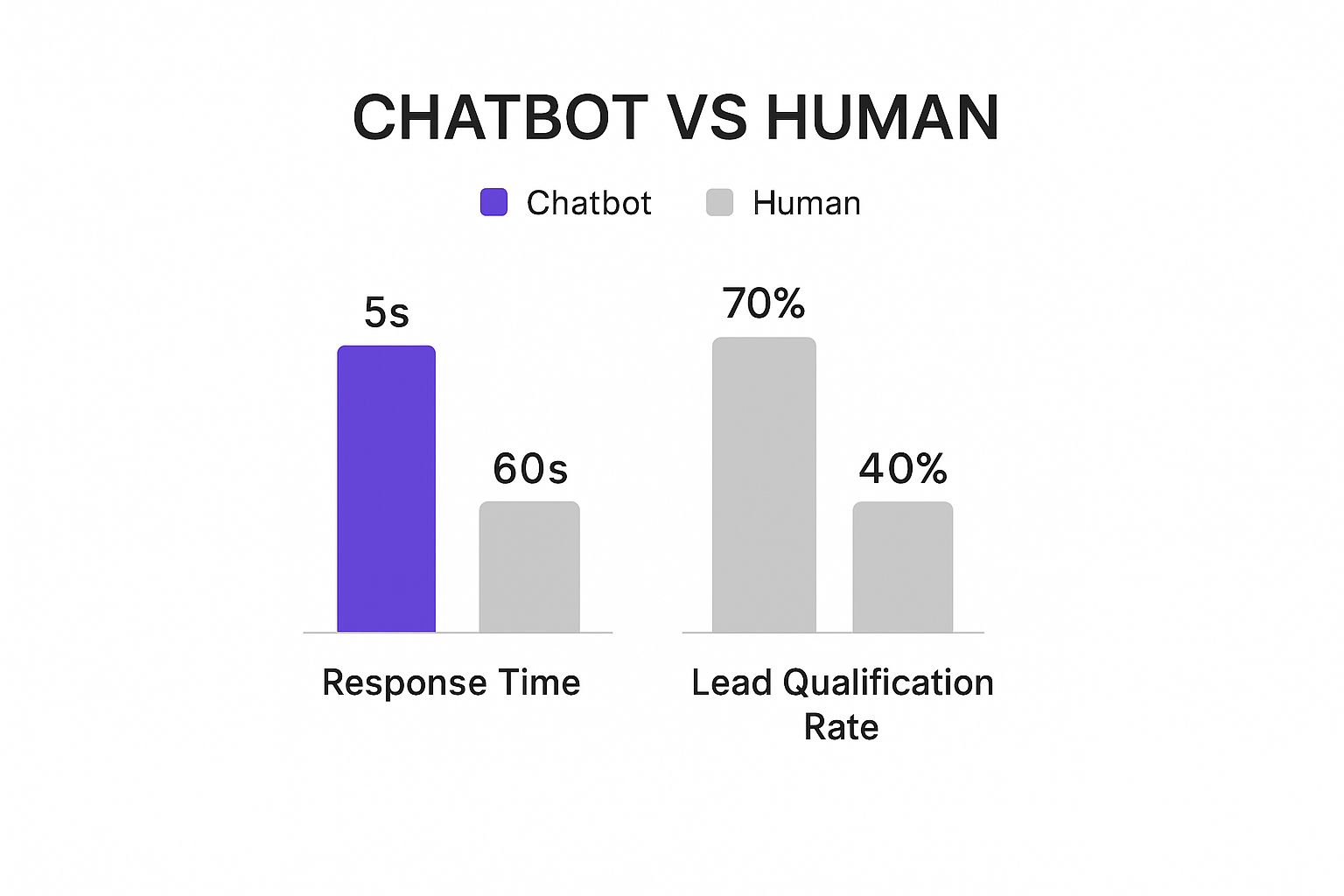
The numbers in the data don't lie. Chatbots consistently crush manual methods when it comes to response time, lead qualification, and ultimately, conversion rates.
The Real Impact on Your Sales Funnel
This conversational approach does more than just replace a clunky form; it fundamentally improves your entire sales funnel. Chatbots are often a core component of effective marketing automation strategies that focus on generating immediate leads and making engagement more efficient.
By pre-qualifying leads before they ever reach a human, chatbots ensure your sales team spends its valuable time talking to high-potential prospects, not chasing down contacts who were never a good fit to begin with.
This isn't just about swapping out a form. It's about completely rethinking the top of your funnel to be more engaging, efficient, and profitable from the very first click.
Starting the relationship with a helpful, immediate interaction builds trust right from the start. It sets the stage for more meaningful sales conversations and, ultimately, helps you close deals faster.
Designing a High-Converting Chatbot Conversation
A chatbot is only as good as the conversation it's designed to have. Think of it less like a piece of software and more like your best sales development rep-one who’s always on, instantly helpful, and skilled at guiding visitors toward a solution. The real magic happens when you masterfully design the dialogue.
Everything starts with a single, clear objective. Before you even think about writing a welcome message, you need to know exactly what you want the chatbot to accomplish. Is its main job to book demos? Qualify prospects for a sales call? Or maybe just point people to the right product page? Every single question and response should drive toward that one goal.
Crafting the Opening Gambit
That first message your chatbot sends is everything. It’s your digital first impression, and it needs to be engaging while clearly stating its purpose. Ditch the generic, passive greetings like "How can I help you?" Be proactive and specific instead.
Here are a couple of real-world examples:
- For a SaaS company: "Hi there! Looking for a better way to manage your projects? I can help you find the right plan or book a quick demo."
- For an e-commerce store: "Welcome! Need help finding the perfect gift? I can give you some personalized recommendations. What's the occasion?"
This approach immediately shows the user what's in it for them and gives them a clear path forward, making them much more likely to engage.
The Art of Smart Qualification
Once a visitor starts chatting, the real work begins. Your goal is to ask smart qualifying questions that feel like a natural part of a conversation, not a robotic interrogation. This is your chance to gather the essential details your sales team needs without making the user feel pressured.
The best way to do this is to structure your questions from broad to specific. Start with easy, low-commitment questions to build a bit of rapport before you ask for their contact info.
Take a look at this e-commerce flow:
- Initial Question: "Are you shopping for yourself or someone else today?" (Broad and easy)
- Follow-up: "Great! What's your budget for this gift?" (More specific, helps with qualification)
- Offer: "Perfect. I have a few ideas. Can I email you a curated list of options?" (Captures the lead)
This gradual exchange feels helpful, not transactional. When you’re mapping out your chatbot’s dialogue, understanding how you're leveraging AI for sales strategies is a huge advantage.
The key is to make every interaction a value exchange. The user gives you a piece of information, and in return, you provide a more tailored, helpful response. This builds momentum toward the final conversion.
Of course, the technical setup behind these conversation flows is just as important. Our complete guide on https://www.whisperchat.ai/blog/how-to-implement-a-chatbot breaks down the essential steps to get your bot live and running on your site.
Handing Off the Lead Seamlessly
The final, crucial step in the conversation is the handoff. After the chatbot has qualified a lead, it needs to create a smooth transition to your sales team. This could mean scheduling a meeting directly on a rep’s calendar or pushing the chat transcript and contact details right into your CRM.
For example, a real estate chatbot might wrap up with: "It sounds like our downtown lofts are a perfect match for your needs. Sarah, our loft specialist, is available to give you a virtual tour. What time works best for you this week?"
This makes the handoff feel like the next logical step in a helpful journey, not an abrupt end to the chat. By carefully designing each stage, you transform a simple chat widget into a powerful engine for chatbot lead generation.
Weaving Your Chatbot into Your Tech Stack
A chatbot on its own is fine, but one that’s plugged into your other tools? That’s where the magic really happens for chatbot lead generation. When your bot is isolated, it just creates another data silo and adds more manual work to your plate. Frankly, that defeats the whole purpose.
The real power gets unlocked when your chatbot talks seamlessly to the software you already rely on. This is how you elevate a simple Q&A bot into the command center of your automated marketing and sales machine. It’s all about creating a smooth, unbroken path for information to travel-from that first "hello" on your website to a closed deal.
This flow gets rid of the soul-crushing data entry and puts your entire lead process into a higher gear.
Hooking into Your CRM for Immediate Action
If there's one integration you absolutely must set up, it's with your Customer Relationship Management (CRM) system. When your chatbot successfully qualifies a lead, that information can't just die in the bot's backend. Your sales team needs it, and they need it now.
Connecting your chatbot directly to a CRM like Salesforce, HubSpot, or Odoo lets you automate some incredibly powerful workflows.
- Create new contacts the second a visitor gives you their email. No delay.
- Log the full chat history right onto the contact's record. This gives your sales team the complete picture.
- Update the lead's status automatically based on how they answered qualification questions.
- Assign the new lead to the right salesperson based on territory, expertise, or even current workload.
Imagine this scenario: a visitor is on your pricing page and tells the bot they have a team of over 50 people. With the right integration, a new lead is instantly created in Salesforce, tagged as "Enterprise," and assigned to your top account executive. This all happens in real-time, while the prospect is still on your site. The friction that lets hot leads go cold? Gone.
Your sales team shouldn't have to copy-paste lead details from one system to another. A proper CRM integration means they get a notification with a fully-qualified, context-rich lead dropped right into their workflow, ready for immediate follow-up.
Automating Nurturing and Seeing the Whole Picture
The CRM is just the beginning. To build a truly cohesive system, you need to connect your bot to your other marketing and analytics platforms.
Take your email marketing software. When a bot grabs an email address from someone curious about a specific product, it can instantly add them to a tailored email sequence in a tool like Mailchimp or Klaviyo. The conversation keeps going long after the chat window closes, keeping your brand fresh in their mind.
Then there are analytics. An integration with a platform like Google Analytics lets you track chatbot interactions as specific conversion events. Suddenly, you have a complete, end-to-end view of the customer journey. You can see exactly which pages are generating the most chatbot leads and what those leads do next.
Create your free AI support chatbot
Train WhisperChat on your website content and start answering repetitive customer questions in minutes.
Start FreeThis seamless data flow is what turns a decent chatbot lead generation strategy into a truly great one.
Using Data to Sharpen Your Chatbot's Performance
Getting your chatbot live on your site is just the beginning. The real magic happens next. It’s the continuous process of digging into the data and refining your bot that turns it from a neat feature into a genuine lead generation powerhouse. If you just set it and forget it, you’re leaving money on the table.
The first step is to look past the vanity metrics. Sure, knowing the total number of chats is interesting, but it doesn't tell you if the bot is actually helping your business. You need to zero in on the key performance indicators (KPIs) that connect directly to your bottom line.
The Metrics That Actually Move the Needle
To get a real sense of how your chatbot is doing, you have to track the right things. These numbers give you a clear window into how users are interacting with your bot and whether it's doing its job effectively.
- Engagement Rate: This is simple: what percentage of your visitors are actually starting a chat? If this number is low, your chat widget might be in the wrong spot, or your welcome message just isn't grabbing anyone's attention.
- Conversation Completion Rate: Of all the chats that get started, how many actually end with a successful outcome, like a captured email or a booked demo? This metric tells you everything about how well your conversation flows are designed.
- Lead Quality Score: Are the leads any good? This is a crucial one. You’ll need to work with your sales team to define what a "quality" lead looks like. Score leads based on the info the bot gathers-things like company size, job title, or the specific problems they're trying to solve.
One of the biggest wins with a chatbot is its impact on inbound lead response time. A bot gives you instant engagement, which is a massive advantage. But you have to make sure that speed continues when the conversation gets handed off to a human.
Finding Gold in Your Conversation Logs
Seriously, one of the most valuable things you can do is to actually read the chat transcripts. Your conversation logs are an absolute goldmine of unfiltered customer feedback.
The goal isn't just to see what users are saying, but to understand why they're saying it. Every chat log is a free lesson in customer intent.
Look for the rough spots. Where do people seem to get confused or just give up? Are they asking the same questions over and over that your bot can't answer? These "unhandled intents" are your to-do list for optimization. Each one is a clear signal of where you need to add a new conversational path or expand the bot's knowledge.
For a more structured look at what to track, we've put together a guide on the essential chatbot analytics you should be monitoring.
This data highlights how businesses use predictive insights to prepare for the future.
Looking ahead, AI can even help predict lead behavior by analyzing trends. This allows you to be more proactive, anticipating what your customers might need next and adjusting your strategy before your competitors do. You can find more lead generation statistics on databox.com that speak to this trend.
A Smart Framework for A/B Testing
Once you've spotted some areas for improvement in the data, it's time to experiment. But don't just make changes based on a gut feeling. A/B testing is how you prove your ideas work.
The key is to test one thing at a time. Otherwise, you'll never know what actually made the difference.
Here are a few ideas to get you started:
- The Welcome Message: Try a few different openers. Does a direct question outperform a simple greeting?
- Qualifying Questions: Play with the order or wording. Does asking for an email at the beginning of the chat kill the conversation? What if you ask at the end?
- Buttons vs. Free Text: See what works best for your audience. Do they prefer the ease of clicking pre-defined buttons, or do they want to type out their own answers?
This cycle of analyzing metrics, reading transcripts, and running structured tests creates a powerful feedback loop. It’s this data-driven discipline that transforms a pretty good chatbot into an absolutely essential part of your marketing and sales funnel.
Squeezing More ROI Out of Your Chatbot: Advanced Strategies
Alright, so your chatbot is up and running. It's greeting visitors and collecting a few leads. That's a great start, but it's just the beginning. To truly see a significant return on your investment, you need to move beyond the basic "Hi, how can I help you?" and into smarter, more proactive tactics.
This is where the magic really happens. We're talking about making your bot a genuinely intelligent part of your sales team-one that knows when and how to engage for maximum impact.
Engage Visitors with Proactive Triggers
A chatbot that just sits there waiting to be clicked is leaving money on the table. A truly effective bot acts like a sharp salesperson who knows the perfect moment to step in and start a conversation. You can do this by setting up proactive triggers based on visitor behavior.
Think about these real-world scenarios:
- Time on Page: Someone’s been lingering on your pricing page for more than 60 seconds. That's a huge buying signal! Instead of staying silent, your bot can jump in with, "Looks like you're comparing our plans. Can I help you figure out which one is the best fit?"
- Exit-Intent: A visitor's mouse suddenly darts towards the close button. Before they disappear forever, your bot can pop up with a final offer or a simple question. "Wait! Before you go, would you be interested in a 10% discount code?" This can be surprisingly effective at rescuing leads.
- Scroll Depth: They’ve scrolled 75% of the way down a detailed product page. They're clearly invested. This is the ideal time for your bot to offer something valuable, like "You seem interested in the details. Would you like to see a live demo with one of our specialists?"
By using triggers, your bot stops being a passive tool and becomes an active asset, hunting for high-intent visitors and engaging them at their peak interest.
Personalize Conversations with CRM Data
Personalization is a total game-changer, especially for returning visitors. When you connect your chatbot to your CRM, you can greet people by name and reference their past interactions. It moves the conversation from generic to genuinely personal.
For instance, imagine a prospect who downloaded your guide on social media marketing last week comes back to your site. Instead of the standard greeting, your bot could say:
"Welcome back, Sarah! Hope you found the social media guide helpful. Are you ready to see how those strategies could look for your own business?"
This small touch makes a massive difference. It shows you're paying attention and that they aren't just another faceless visitor. It builds trust and dramatically accelerates the sales process by picking up the conversation right where it left off. This kind of contextual awareness is central to a successful chatbot for lead generation.
The Financial Impact of AI Implementation
The efficiency you gain from a well-implemented AI chatbot is incredible. Chatbots can handle up to 80% of routine questions on their own, which has a direct and immediate impact on your bottom line. Automating those initial chats can save a business hundreds of thousands of dollars a year in labor costs alone.
But it's not just about cutting costs. It’s about reallocating your most valuable resource: your people. When your skilled sales and support teams are freed from answering the same questions over and over, they can focus on what humans do best-closing complex deals, nurturing key relationships, and solving unique customer problems. That shift in focus is what really drives a massive boost to your overall ROI.
Hesitant About Chatbots? Let's Address the Common Questions
Even knowing all the potential upsides, it's completely normal for teams to feel a bit hesitant about jumping into chatbot lead generation. I've heard the same concerns pop up time and again-worries about annoying users, the technical lift, and whether you can even prove it's working.
These are all valid points. Let's tackle them head-on, based on what I've seen work in the real world.
"Will a Chatbot Just Annoy My Website Visitors?"
This is probably the number one fear I hear, and for good reason. We've all been on the receiving end of a terrible pop-up or a bot that just won't go away. The trick is to stop thinking of it as a pushy salesperson and start designing it like a helpful store assistant.
A great chatbot doesn't interrupt-it assists. It appears at the right moment, offering value when a visitor is clearly looking for something. Imagine it only popping up after someone has spent 30 seconds on your pricing page, or after they've visited the same product page twice. When it's helpful and aware of the user's context, a chatbot becomes a welcome addition, not a nuisance.
"How Much Technical Skill Do I Actually Need to Build One?"
Here's the good news: you don't need to be a developer anymore. The idea that you need a full-blown engineering team to launch a chatbot is a myth, thanks to the new wave of no-code platforms designed specifically for marketing and sales teams.
Most modern tools, like Whisperchat.ai, use intuitive drag-and-drop interfaces. You can visually map out entire conversations, create qualifying questions, and add response buttons without ever touching a line of code. Sure, if you need a deep, custom integration with your company's homegrown CRM, you might need a bit of technical help. But for building and launching a powerful lead-gen bot? Your marketing team has this.
A chatbot that's a pain to build or manage will never get used to its full potential. The whole point is to find a platform that lets your team launch, test, and tweak things on the fly without waiting on anyone else.
"How Can I Prove This Is Actually Worth the Investment?"
Measuring the ROI of your chatbot is more straightforward than you might think. It all boils down to tracking a few metrics that tie directly back to your bottom line.
Here’s a simple framework to follow:
- Cost Per Lead (CPL): The most direct comparison. Calculate your chatbot's CPL and put it right next to the CPL from your paid ad campaigns or other channels. You'll quickly see where you're getting the most bang for your buck.
- Lead-to-Customer Conversion Rate: This one is crucial. It's not just about how many leads the bot gets, but how many of them turn into paying customers. This metric tells you if you're capturing high-quality leads.
- Time Saved for Your Sales Team: This is a huge, often overlooked, win. Tally up the hours your reps save now that they aren't manually qualifying every single person who fills out a form. Put a dollar value on that time-it adds up fast.
By keeping an eye on these numbers, you can easily build a business case and show everyone exactly how much value the chatbot is bringing to the table.
Ready to turn your website into a lead generation machine? With Whisperchat.ai, you can build and deploy an AI chatbot trained on your own content in minutes, no coding required. Start converting more visitors and automating your sales pipeline today. Learn more and get started at Whisperchat.ai.
Create your free AI support chatbot
Train WhisperChat on your website content and start answering repetitive customer questions in minutes.
Start Free