
Using AI for Lead Generation to Boost Sales
Unlock sales growth by using AI for lead generation. This guide details how to integrate AI tools, personalize outreach, and find more sales-ready leads.
When you hear about using AI for lead generation, what we’re really talking about is using smart software to handle the entire process of finding, qualifying, and warming up potential customers. It’s a fundamental shift. Instead of just playing a numbers game, you’re making a strategic move toward a value-driven approach. AI takes on the heavy data analysis, freeing up your sales team to do what they do best: build relationships and close deals.
How AI Is Redefining Sales and Lead Generation
The days of manual prospecting and sending out generic email blasts are over. We’ve entered a new era where artificial intelligence is a central part of sales growth, not just another automation tool. When you use AI for lead generation, you're plugging into platforms that sift through enormous datasets to spot high-intent prospects and even predict their buying behavior.
This gives your team the power to send out deeply personalized messages at a scale that was simply unimaginable before. Your reps no longer have to spend hours hunting for contact details or guessing which message will land. AI handles that grunt work, leading to a much more efficient and effective sales process from the very beginning.
A Strategic Move from Quantity to Quality
The core change here is moving away from chasing every single lead to laser-focusing on the ones that actually matter. AI algorithms can score leads instantly, looking at hundreds of signals-from how someone interacts with your website to their social media activity and company details. This intelligent filtering ensures your sales pipeline is consistently stocked with prospects who are genuinely ready to talk.
It’s a complete flip from the traditional model, which often leads to sales reps burning out on low-quality lists and mind-numbing, repetitive tasks.
AI enables a focus on high-value activities. It automates the tedious, data-intensive work, freeing your sales professionals to do what humans do best: connect, empathize, and build trust with potential customers.
The results speak for themselves. Recent lead generation analytics show that companies integrating AI across their sales funnel can achieve over a 50% increase in sales-ready leads. On top of that, they're often able to cut acquisition costs by as much as 60%. This powerful combination of better leads and lower costs is why AI has become a must-have for any competitive sales team.
Traditional vs AI-Powered Lead Generation
To really see the difference, it helps to put the old and new methods side-by-side. The contrast isn't just about efficiency; it's about a complete rethinking of sales strategy.
| Aspect | Traditional Lead Generation | AI-Powered Lead Generation |
|---|---|---|
| Prospecting | Manual research, static lists, and cold calling. | Automated discovery of high-intent prospects using predictive analytics. |
| Qualification | Manual lead scoring based on simple demographics. | Dynamic, real-time lead scoring based on behavior and intent signals. |
| Outreach | Generic, one-size-fits-all email templates. | Hyper-personalized messages crafted by AI for individual recipients. |
| Efficiency | Labor-intensive and slow, with high manual overhead. | Highly automated, allowing for rapid scaling with fewer resources. |
As you can see, the AI-powered approach isn’t just a faster version of the old way-it’s a smarter, more targeted, and ultimately more human-centric way to drive growth.
Building Your AI Lead Generation Playbook

Jumping into AI for lead generation without a plan is a recipe for wasted money and time. It’s not about grabbing the latest shiny tool off the shelf; it's about building a smart, strategic playbook first. This playbook is your roadmap. It ensures your tech investments actually serve a business purpose and gets your whole team on the same page.
It all starts with getting crystal clear on what you’re trying to achieve. Are you simply trying to fill the top of your funnel with more names? Or is the real problem that your sales team is bogged down with low-quality prospects? Maybe your sales cycle is just dragging on for too long. Each of these goals calls for a completely different AI solution.
For example, if you just need more leads, an AI-powered website chatbot can be a game-changer, engaging every visitor. Our own guide on using a chatbot for lead generation shows you exactly how to set one up to capture visitor info around the clock. But if lead quality is the issue, you’d be better off looking at AI tools for predictive lead scoring.
Pinpoint Where AI Delivers Maximum Impact
With your primary goal in mind, the next step is to walk through your current customer journey. Map out every single touchpoint, from the moment someone first hears about you to the day they sign on the dotted line. Where are the friction points? Where are you losing people?
- Top of Funnel: Is finding good prospects a constant struggle? AI can sift through massive amounts of data to build highly specific lists of people who match your ideal customer profile.
- Middle of Funnel: Do promising leads often go quiet? AI can take over, sending automated, personalized follow-ups and content tailored to what a lead has shown interest in.
- Bottom of Funnel: Are deals falling apart right before closing? AI conversation intelligence tools can listen in on sales calls and give your reps live coaching and feedback.
A critical part of your playbook is identifying the right data to fuel your AI. Your AI is only as smart as the information it learns from. This includes internal CRM data, website analytics, and third-party intent data.
This kind of strategic mapping helps you apply AI where it will move the needle most, instead of just sprinkling it everywhere and hoping for the best. This targeted approach is especially powerful with newer forms of AI. For instance, a 2025 study on agentic AI-systems designed to autonomously run lead generation campaigns-found they generate 7 times more qualified B2B leads than traditional methods. They achieve this by hyper-personalizing outreach at a scale humans simply can't match.
By taking the time to build this playbook, you create a cohesive strategy. Every AI-powered action is tied directly to a business outcome you can actually measure. You're not just adopting technology; you're building a smarter, more efficient, and ultimately more profitable lead generation machine.
Choosing the Right AI Tools for Your Sales Funnel
The market for AI tools is booming, and trying to pick the right software can feel overwhelming. The good news? You don't need a dozen different platforms to make an impact. The real secret to using AI for lead generation is matching the right tool to the right stage of your sales funnel. A platform that’s a rockstar at prospecting won't be the same one you use for nurturing warm leads.
This is all about building a smart, targeted tech stack. You're looking for a handful of tools that play well together, plug right into your CRM, and genuinely make your team’s life easier-not more complicated.
AI Tool Comparison
To help you get a handle on what's out there, it's useful to think about tools in terms of their core job. Are you trying to find new people, talk to them, or close the deal? Each requires a different approach.
| Tool Type | Primary Function | Best For | Example Platform |
|---|---|---|---|
| Data Enrichment & Prospecting | Finding and verifying contact/company data | Top-of-funnel list building and outreach | Seamless.ai |
| Conversational AI / Chatbots | Engaging and qualifying website visitors | 24/7 lead capture and appointment setting | Whisper |
| Sales Engagement Platforms | Automating and personalizing outreach | Mid-funnel email sequences and follow-ups | Outreach |
| Sales Intelligence & Coaching | Analyzing call/email data for insights | Bottom-of-funnel deal closing and training | Gong |
This table gives you a starting point. The goal is to build a system where each tool hands off the lead to the next, creating a smooth journey for both the prospect and your sales team.
Aligning Tools with Funnel Stages
Let's break down how this works in practice. Start by looking at your process and identifying the biggest bottlenecks. Where are leads getting stuck?
Top of Funnel (Awareness & Discovery): At this stage, it’s all about volume and accuracy. Your team needs tools for prospecting and data enrichment. Instead of spending hours digging through LinkedIn, a platform like Seamless.ai can pull verified emails and phone numbers in seconds, letting your reps focus on outreach, not research.
Middle of Funnel (Consideration & Qualification): Once someone lands on your site, the clock is ticking. This is where you need to engage and qualify them. AI-powered chatbots are brilliant for this. They can handle visitor questions 24/7, qualify their interest based on predefined criteria, and even book meetings directly on your sales team's calendar. No more missed opportunities.
Bottom of Funnel (Decision & Purchase): As leads move closer to a decision, personalization is everything. AI tools can analyze interaction history to suggest the perfect talking points for a follow-up email or provide your reps with real-time coaching cues during a live sales call.
A quick pro-tip: When you're looking at different AI tools, it helps to have a basic grasp of the technology behind them, like Large Language Models (LLMs). Knowing a little about the engine helps you judge the horsepower and see which vendors are truly innovating.
A Framework for Evaluating Vendors
Okay, you've mapped out your needs. Now, how do you actually choose between different vendors? My advice is to look past the shiny feature list and ask one simple question: "Can this tool solve my specific problem?"
The difference between a traditional approach and an AI-driven one can be stark.
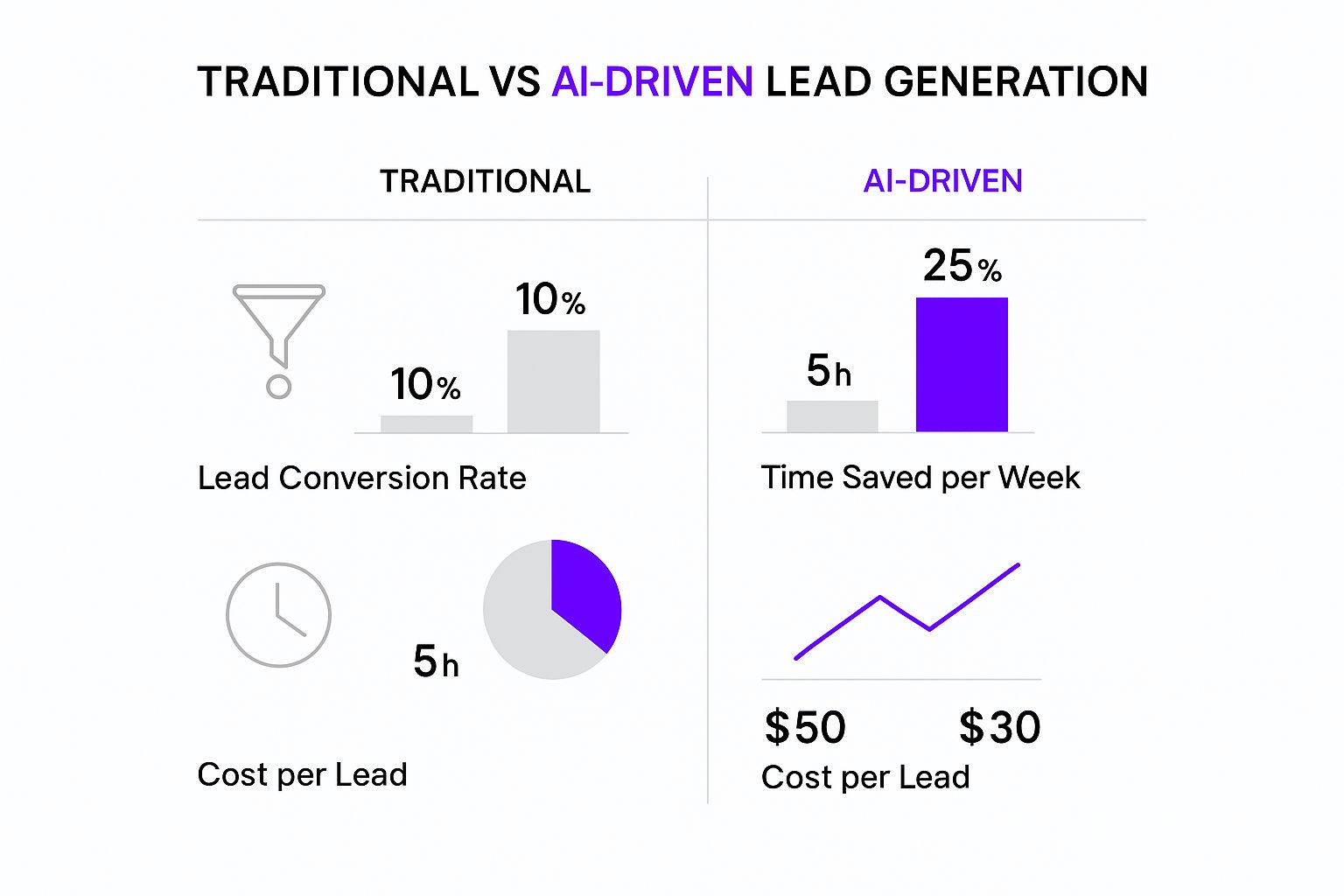
As you can see, AI has a massive impact on key metrics like conversion rates and cost per lead, while drastically cutting down the time it takes to get there.
Don't just take the vendor's word for it, though. Get real-world feedback from review platforms.
Sites like G2 are invaluable. They offer honest, unfiltered reviews from actual users. This is where you’ll find the truth about a tool's ease of use, quality of customer support, and overall reliability-factors that are just as important as the features themselves.
Ultimately, the best AI tools are the ones that feel like a natural extension of your team. For a deeper look at how AI can act as a dedicated partner, check out our guide on creating an https://www.whisperchat.ai/blog/ai-agent-for-sales. By thoughtfully picking technology for each stage of the funnel, you’re not just buying software; you’re building a growth engine.
Integrating AI Into Your Team's Daily Workflow

This is where the rubber meets the road. You can have the best AI strategy in the world, but if you can’t get your team to actually use the tools, it’s all for nothing. Weaving AI into your team's day-to-day without creating a tangled mess is what separates a successful rollout from a failed investment.
The first practical hurdle is getting your data to flow seamlessly. This means hooking your new AI platforms directly into your Customer Relationship Management (CRM) system. When your AI chatbot qualifies a lead or a predictive tool scores a prospect, that information needs to show up instantly where your sales team lives-inside the CRM. This simple connection is a huge win, eliminating manual data entry and killing off data silos before they even start.
Once the tech is talking, it’s all about the people. Just dropping a new tool on your team and hoping for the best is a classic mistake.
Building Trust and New Habits
Training isn’t just a "click here, then here" walkthrough. It’s about getting your team to trust the AI's recommendations and building new routines around them. Your sales and marketing folks need to understand, on a practical level, how the AI comes to its conclusions and why it’s suggesting a certain action.
For example, what happens the moment a lead gets a high predictive score from your AI? You need a clear playbook. Does it get routed to a senior rep right away? Does it trigger a specific email sequence? Get these workflows down on paper.
Think about a few operational tweaks you'll need to make:
- Handling AI-Qualified Leads: Create a special queue or tag in your CRM for leads vetted by an AI chatbot or scoring tool. This is a clear signal to your team: these are hot.
- Making Sense of Predictive Scores: Train your reps on what the numbers mean. A score of 95 might mean "call immediately," while a 70 is better for a nurturing campaign.
- Using AI-Generated Insights: If your tool suggests conversation starters or pinpoints a prospect's main challenge, show your team how to work that into their very first email or call. It’s a game-changer for personalization.
I’ve found that a phased rollout almost always works best. Start with a small pilot group-a few of your most tech-savvy or open-minded reps. Let them become your internal champions who prove the tool’s value before you push it out to everyone.
A Phased Rollout for Lasting Success
Starting small is your best defense against chaos. It lets you work out the kinks in a controlled environment. Pick your pilot group and give them clear, measurable goals. For instance, you could challenge them to boost their lead-to-meeting conversion rate by 15% in the first month.
Keep a close eye on their progress, but more importantly, collect their honest feedback. What’s working? What’s clunky or confusing? Use their real-world experience to fine-tune your training and workflows.
When you can go to the rest of the company and share a genuine success story-"Sarah’s team booked 20% more meetings last month using the new AI assistant"-you create powerful social proof. That’s what gets everyone else excited to jump on board. This kind of thoughtful, people-focused integration is how you make sure your AI investment becomes a core part of your growth engine, not just another subscription gathering dust.
Measuring and Optimizing Your AI Strategy
Putting AI tools in place is one thing, but that’s really just the starting line. The real magic of using AI for lead generation happens when you tap into its ability to learn and get better over time. This isn’t a "set it and forget it" kind of deal; it demands a solid process for measuring what’s working and what’s not, so you can continuously fine-tune your approach.
It’s all about moving past vanity metrics and homing in on the numbers that actually drive revenue.
Identifying Your Core KPIs
First things first, you need a clear dashboard to track the most important data points. Think of this as your mission control for AI performance. It’s where you’ll go to make informed decisions instead of just guessing what’s effective.
Here are the key metrics I always tell clients to watch:
- Conversion Rate from AI-Scored Leads: This is the big one. What percentage of the leads your AI flagged as high-potential actually became paying customers? This is the ultimate stress test for your AI’s accuracy.
- Reduction in Customer Acquisition Cost (CAC): As your AI takes over more of the heavy lifting in prospecting and qualification, your CAC should drop. Tracking this helps you put a real dollar amount on the efficiency you're gaining.
- Impact on Sales Cycle Length: A well-oiled AI machine should speed things up, shortening the time it takes to turn a new lead into a closed deal. Are you seeing your sales pipeline move faster? Measure it.
The real work is in the cycle: analyzing data, getting feedback from your sales team, and tweaking your AI models. This is what turns a good setup into a great one that consistently fuels growth.
Focusing on these bottom-line metrics gives you a crystal-clear picture of the return on your AI investment. This data-driven approach not only builds confidence across your company but also makes it much easier to justify spending more on these tools.
And the financial upside is well-documented. A 2025 McKinsey report found that businesses using AI for lead generation saw revenue increases between 3% and 15% and a 10% to 20% jump in sales ROI. These numbers come from AI’s knack for automating tasks, scoring leads with precision, and creating personalized outreach at scale. You can discover more insights from the 2025 lead generation trends report to get the full story.
The Art of Iterative Improvement
Once you have your tracking set up, the real optimization work begins. Think of it as an ongoing cycle of testing and refining. Don't be shy about experimenting with different models or outreach strategies to see what clicks with your audience.
Here’s a practical example of what this looks like:
- Form a Hypothesis: You might believe that an AI-generated email referencing a prospect's recent LinkedIn activity will outperform a generic one.
- Run a Test: Split your list. Group A gets the hyper-personalized email, while Group B receives your standard template.
- Analyze the Results: After a week or two, dig into the data. Compare the response rates, meetings booked, and ultimately, the conversion rates for both groups.
- Refine Your Approach: If Group A's results are significantly better, that personalized approach becomes your new baseline. Then, you start looking for the next thing to test and improve.
This constant feedback loop is absolutely essential. It ensures your automated sales funnel gets smarter and more effective over time, adapting to shifting market dynamics and customer preferences. The goal isn't just to generate leads-it's to build a system that learns how to generate better leads with every single interaction. That’s how you build a real, lasting competitive edge.
Your Top Questions About AI in Lead Generation, Answered
Jumping into AI for lead generation always brings up a few practical questions. It's a significant move, and it's smart to think through the real-world impact on your budget, your team, and your sales process. Let's tackle some of the most common concerns I hear from business owners.
Isn't AI for Lead Generation Too Expensive for a Small Business?
This is probably the biggest myth out there. While it's true that massive, enterprise-level AI systems can have a scary price tag, the reality is the market is now full of powerful, scalable tools that are surprisingly affordable. Many have monthly plans starting under $50/month.
The trick is to start small and focused. Don't try to change everything overnight. Pick one specific, high-impact area to improve. For example, adding an AI-powered chatbot to your website is a fantastic first step. It can engage visitors and capture leads 24/7, even when your team is offline.
Often, the new leads and efficiency gains from that single tool will deliver a positive ROI, paying for the software and proving the case for expanding your use of AI down the road.
Is AI Going to Replace My Sales Team?
Absolutely not. Think of AI as an incredibly powerful assistant for every single person on your sales team, not a replacement. The goal is to amplify your team's talent by taking over the monotonous, time-consuming tasks that bog them down.
AI is a workhorse for the repetitive, data-heavy stuff that humans frankly find draining.
- It can sift through thousands of contacts to pinpoint the most promising ones.
- It can score leads in real-time using hundreds of data points.
- It can handle the initial follow-up emails to warm up a new prospect.
This frees up your sales reps to do what they do best: build relationships, give fantastic demos, and navigate the nuances of closing a deal. AI handles the "who" and "when," so your team can focus on the "how" and "why."
"AI gives our loan officers the tools and the data that they need to advise customers and to execute, especially on lead conversion." - Gemma Currier, Senior Vice President of Retail Sales Operations at Guild Mortgage
How Can I Get My Sales Team to Actually Use These New AI Tools?
Getting your team on board is a classic challenge, but it's entirely manageable. Success comes down to two things: showing them the value and making it easy. Just dropping a new tool on them from on high is a recipe for failure.
My advice? Start with a pilot program. Hand-pick a few of your most open-minded or tech-savvy reps and let them be the trailblazers. Show them exactly how the tool helps them hit their quota with less grunt work. Provide great training and create dead-simple workflows to get them started.
Once you have a success story-even a small one-shout it from the rooftops. When other reps see their colleagues closing more deals and earning bigger commissions, their skepticism will quickly turn into curiosity. It’s all about building momentum with real, undeniable results.
Ready to see how an AI-powered chatbot can turn your website into a lead-generating machine? Whisperchat.ai lets you train a custom AI on your own data in minutes, with no coding needed. Start your free trial and deploy your first chatbot today.