
Top Chatbot for Small Business: Boost Sales & Save Time
Discover how a chatbot for small business can save time, increase sales, and enhance customer service. Learn how to choose and implement yours today!
Picture this: a team member who’s on the clock 24/7, never calls in sick, and can answer nearly every routine customer question in a heartbeat. That's what a chatbot for a small business is-your most reliable digital employee, ready to cut down your operational costs while making your customers happier.
Your Hardest-Working Digital Employee
If you’re a small business owner, you know the grind. You’re not just the CEO; you’re the head of marketing, the entire sales team, and the full-time customer support specialist. It’s a constant balancing act that can pull you away from what you should be doing: growing the business.
Now, imagine offloading all those repetitive, time-sucking tasks to a smart assistant.
That's where a chatbot becomes your secret weapon. This isn't just another piece of tech; it’s a practical, powerful tool that hums along quietly in the background. Think of it as the world’s most efficient receptionist, one who never needs a lunch break and is always on deck to help a customer, whether it's 2 PM or 2 AM. This frees you and your team to focus on the things that actually require a human touch-like solving complex problems, nurturing promising leads, or just building real relationships with your customers.
Let's break down the core advantages a chatbot brings to the table right from day one.
Immediate Chatbot Benefits for Your Business
| Benefit | Impact on Your Business |
|---|---|
| 24/7 Availability | You never miss an opportunity. Customers get answers and support even when you’re closed. |
| Instant Responses | No more "we'll get back to you." Chatbots provide immediate answers, boosting customer satisfaction. |
| Cost Savings | Dramatically reduces the hours spent on repetitive support tasks, freeing up staff for high-value work. |
| Automated Lead Gen | Captures contact info from website visitors around the clock, turning casual browsers into real leads. |
These aren't just minor tweaks; they're fundamental improvements to how you operate.
The Immediate Impact on Your Business
Chatbots aren't just for mega-corporations with massive call centers anymore. Their real magic lies in how they level the playing field, giving smaller businesses the power to be incredibly efficient.
Small businesses are catching on fast. A well-trained chatbot can handle up to 80% of standard customer questions, which can lead to saving as much as 30% on customer support costs.
That's a direct and immediate impact. Think about all the time you or your staff spend answering the same things over and over-"What are your hours?", "Do you ship to my area?", "How much does it cost?". A chatbot takes care of all that instantly. For many small teams, an AI Receptionist for Small Businesses becomes a core part of their operations, not just an add-on.
From Cost Center to Growth Driver
Here’s the thing: a good chatbot doesn't just cut costs. It actively helps you make more money.
- 24/7 Lead Capture: Your website doesn't sleep, and neither should your sales efforts. A chatbot engages visitors who show up after hours, answers their first few questions, and grabs their contact details. Just like that, you're generating qualified leads while you sleep.
- Enhanced Customer Satisfaction: We live in an instant-gratification world. Fast, accurate answers build trust and make customers feel valued. That great experience is what brings them back again and again.
Ultimately, a chatbot shifts your customer support from a line item on your expense sheet to a powerful engine for growth. It’s about working smarter, not harder. Want to dig into more numbers? The chatbot statistics on SlickText.com show just how much they’re changing the game.
How Chatbots Actually Work For You

Let's pull back the curtain on how these tools operate. You don’t need to be a tech wizard to get it-understanding a chatbot is actually pretty straightforward. To see why they're so effective for small businesses, it helps to first understand what exactly are chatbots and how they’ve grown from simple scripts into genuinely smart assistants.
At its heart, a chatbot is a computer program that talks with people. Simple as that. But they're not all built the same way. They generally fall into two camps, each with its own way of handling customer conversations.
The Two Main Flavors of Chatbots
First up, you have Rule-Based Chatbots. Think of this one like a sophisticated phone menu-the kind that says, "Press 1 for store hours, Press 2 for your order status." It works off a script you design, guiding users down a set path using buttons and pre-made options.
- How it works: It’s all about “if-then” logic. If a user clicks “Find a Location,” then the bot shows them a map or asks for their zip code.
- Best for: Straightforward, predictable tasks. Things like booking appointments, checking order statuses, or answering the most common questions you get every single day.
The other, more advanced option is the AI-Powered Chatbot. This is less like a phone menu and more like having your sharpest employee on duty 24/7. Instead of being locked into a script, it uses artificial intelligence to figure out what people are asking and respond naturally.
The "Magic" Behind AI Chatbots
So, what's the secret sauce? It’s a technology called Natural Language Processing (NLP). In plain English, NLP is what allows the bot to read a person’s message, grasp what they really mean (their intent), and then give them a useful answer.
For instance, a customer could type any of these:
- "Where's my stuff?"
- "Shipping update please"
- "When will my package get here?"
An AI bot with NLP recognizes that all three questions are asking the same thing: "I want to track my order." It doesn't need the user to click a "Track Order" button; it just understands the request and pulls up the tracking info.
The Bottom Line: An AI chatbot doesn't just look for keywords; it understands the meaning behind the words. This lets it field a huge variety of questions and even learn from past conversations to get better over time.
This ability to learn is what makes AI chatbots such a game-changer for small businesses. They adapt to new customer questions, spot trends in what people are asking for, and deliver a genuinely helpful experience that a rigid script just can't match. The more it interacts, the smarter it gets, making it an asset that appreciates in value. That’s the real difference between a bot that just follows a flowchart and one that truly works for you.
Real-World Chatbot Strategies for Growth
It’s one thing to understand the mechanics of a chatbot, but it's another thing entirely to see it drive real, measurable growth for a business. Let's step away from the technical jargon and look at how small businesses are actually using this technology to improve their operations, save precious time, and ultimately boost their bottom line.
These aren’t just ideas on a whiteboard-they're proven strategies that deliver results day in and day out. As we walk through these examples, you can start to picture exactly how a chatbot could become a workhorse for your own business.
The market is already telling this story loud and clear. The global AI chatbot market is expected to balloon to around $46–47 billion by 2029. Small businesses are a huge driver of this trend, making up 40% of all chatbot users. This isn't surprising when you learn that 81% of sales teams using AI see their revenue climb. You can dive deeper into these AI chatbot stats on Thunderbit.com.
Instant Support for E-commerce Stores
Imagine you run a boutique online store selling handcrafted leather goods. Your inbox is a constant flood of the same questions: "What's your return policy?" "Do you ship internationally?" "How do I care for my new bag?" Answering these one by one eats up hours you should be spending on creating new products or marketing your brand.
This is where a simple chatbot can be a game-changer.
- The Problem: Repetitive customer questions are creating a support bottleneck and causing potential buyers to hesitate.
- The Chatbot Solution: The bot is fed your store policies and FAQ content. When a visitor asks about shipping, it instantly delivers a clear, helpful answer.
- The Result: Customers are happier because they get answers right away, and you get your time back. Shoppers find the info they need to click "buy" without ever having to leave the product page.
Proactive Lead Generation for Service Businesses
Now, let's picture a local landscaping company. Most new clients find you online, but many are browsing your site late at night when no one is around to take a call. They look around and then they're gone, often without a trace.
This is a golden opportunity for a chatbot to step in. For a deeper look at this strategy, check out our guide on chatbot lead generation.
A chatbot acts as your digital receptionist, engaging visitors the moment they show interest. Instead of a passive "Contact Us" form, the bot actively starts a conversation, asking qualifying questions and booking appointments directly into your calendar.
Suddenly, your website isn't just a digital brochure; it's an automated lead-qualifying machine. The bot can ask about their project, budget, and location, so by the time you talk to them, you already know they're a serious prospect ready to talk business.
Automated Sales Assistance for Digital Products
Think about a creator who sells online courses. A potential student lands on your website, feeling interested but a little overwhelmed. They can't decide if the "Beginner's Guide to Video Editing" or the "Advanced Cinematic Techniques" course is right for them.
A chatbot can step in and act as a skilled digital sales assistant.
- Engage: The bot pops up with a friendly greeting: "Hi there! Looking for the perfect course to build your skills? I can help point you in the right direction."
- Qualify: It then asks a couple of simple questions, like "What's your current experience with video editing?"
- Recommend: Based on their answers, the bot confidently suggests the best-fit course and provides a direct link to the sales page.
This guided selling approach clears up confusion, builds the customer's confidence, and directly boosts sales by connecting people with the exact product they need.
Choosing the Right Chatbot Platform
With so many options out there, picking the right chatbot for your small business can feel overwhelming. The secret is to ignore the flashy sales pitches and zero in on what truly matters for your day-to-day work and future growth.
Think of it like buying a company vehicle. A sleek sports car looks great but won't help you haul equipment. A giant truck is overkill for simple city deliveries. You need the right tool for the job. The same holds true for a chatbot.
Evaluate Ease of Use
First things first: how easy is this thing to actually build and manage? While most platforms today are built for people who aren't coders, there's a definite spectrum of user-friendliness.
- No-Code Platforms: These are your best bet if you're not a tech whiz. They use visual, drag-and-drop editors and simple menus. If you can map out a basic flowchart on a whiteboard, you can build a chatbot. This is the perfect starting point for most small business owners who need something effective up and running fast, without needing to hire a developer.
- Low-Code Platforms: These offer a bit more horsepower for those who are comfortable with some light technical work. You might need to write a small snippet of code to connect to a unique database or trigger a custom action, but in return, you get much greater control.
- Custom Development: This is the full-blown, built-from-scratch option. It offers unlimited customization but requires significant time, a dedicated development team, and a much larger budget. It's generally reserved for large enterprises with very specific, complex needs.
For the vast majority of small businesses, a no-code solution hits that sweet spot of power and simplicity.
To help you see the differences at a glance, here’s a breakdown of what you get with each approach.
Comparing Chatbot Platform Types
This table compares the essential features across different types of chatbot platforms, helping you make a more informed choice for your business needs.
| Feature | No-Code Builder | Low-Code Platform | Custom Development |
|---|---|---|---|
| Technical Skill | None required; uses visual, drag-and-drop | Basic coding knowledge helpful, not always mandatory | Expert developers and engineers required |
| Setup Time | Hours to days | Days to weeks | Months to years |
| Cost | $ (Affordable monthly subscriptions) | $$ (Higher-tier subscriptions or usage fees) | $$$$ (Significant upfront and ongoing costs) |
| Flexibility | Good, within the platform's set features | High, allows for more advanced integrations | Unlimited, built entirely to spec |
| Best For | Small businesses, quick deployment, core tasks | Businesses with some tech staff needing more power | Large enterprises with unique, complex needs |
Ultimately, the goal is to find a platform that empowers you, not one that creates another technical headache.
Check Integration Capabilities
A chatbot shouldn't be a stand-alone tool operating in a silo. It needs to communicate with the other software you already rely on to run your business. Before you sign up for anything, double-check that the platform can seamlessly connect to your essential systems.
Your chatbot becomes exponentially more powerful when it can talk to your other systems. An isolated chatbot answers questions; an integrated chatbot drives business processes.
For instance, can it automatically add new leads to your CRM, like Salesforce or HubSpot? Can it pull up order status details from your e-commerce platform, such as Shopify? Solid integrations transform a simple Q&A bot into an automated workhorse that eliminates manual data entry and saves you a ton of time.
The impact of this automation is crystal clear when you look at the numbers.
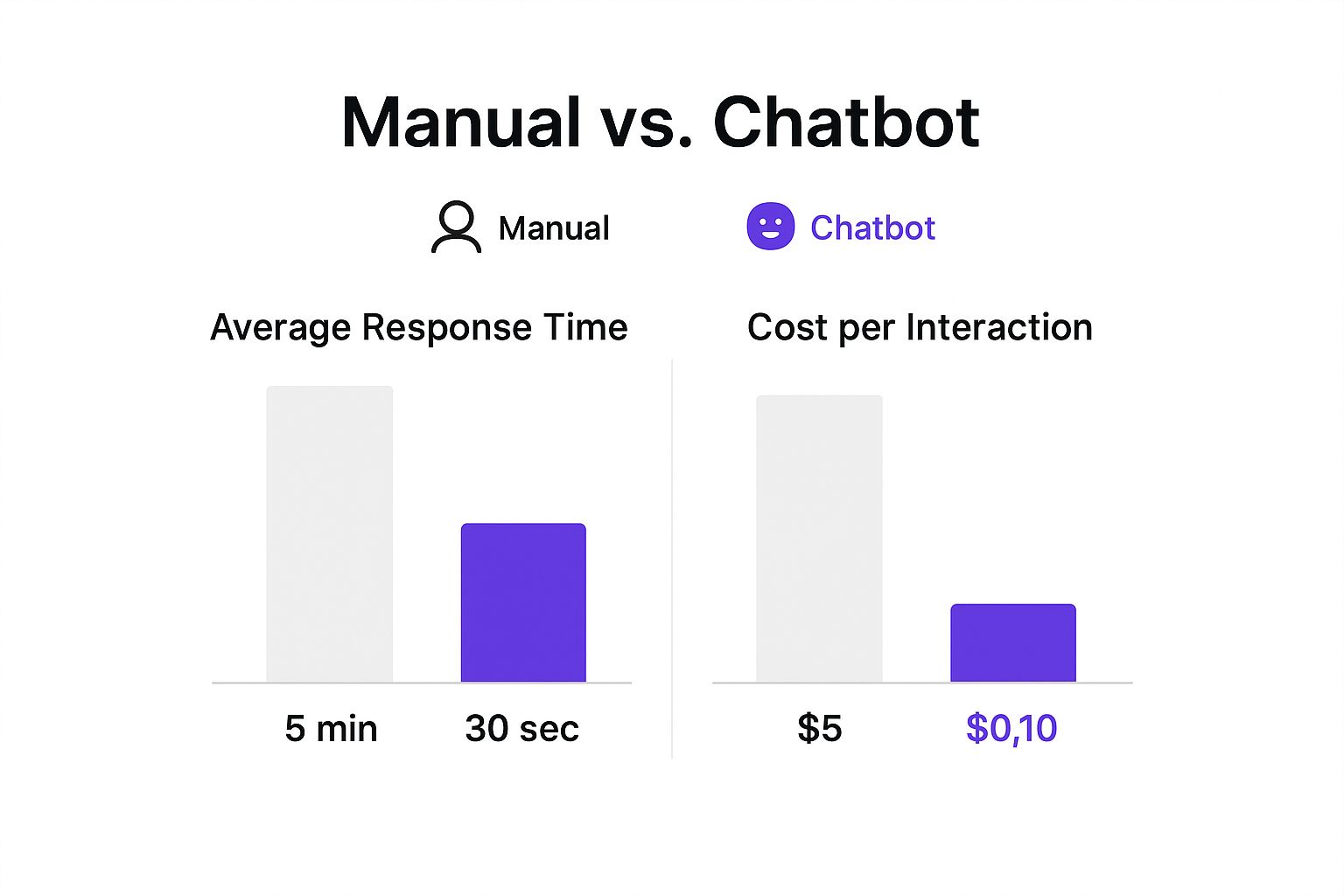
As the data shows, a chatbot can drastically cut down on both the time and money you spend handling each and every customer interaction, freeing you up to focus on growing your business.
Your First Chatbot Implementation Roadmap

Jumping into the world of chatbots can feel like a big leap, but getting your first one up and running is more straightforward than you might think. The secret is to start small. Don't try to build a digital brain that knows everything about your business on day one.
Instead, think of it like training a new team member. You wouldn't throw the entire company handbook at them and expect mastery. You'd start with one critical task they can learn well. Your first chatbot should be no different.
Phase 1: Define One Clear Goal
Before you even think about dialogue, you need to answer one question: What is the one primary problem this chatbot will solve? This is the most important step. A vague goal like "improve customer service" is a recipe for frustration because you can't measure it effectively.
Get specific. A goal like "cut down on support emails about order status by 20%" is perfect. It’s clear, actionable, and gives you a concrete benchmark for success. This focus will guide every decision you make from here on out.
Phase 2: Script a Helpful Conversation
With a sharp goal in place, it's time to map out the conversation. Simplicity is your friend here. Start by listing the top five questions you get that are directly related to your goal.
For example, if your goal is to handle order inquiries, your list might look like this:
- "Where is my order?"
- "Can I change my shipping address?"
- "What's your return policy?"
Write out clear, friendly, and direct answers for each. This initial script becomes the foundation of your bot's knowledge, allowing it to immediately tackle your most common questions. If you want a deeper dive, our guide on https://www.whisperchat.ai/blog/how-to-implement-a-chatbot walks you through the entire process.
The best chatbots for small businesses aren't the ones that try to do everything. They're the ones that do a few things perfectly, creating a genuinely helpful experience that keeps customers happy.
Phase 3: Test, Launch, and Improve
Once your script is ready, it's testing time. Ask your team to interact with the bot. Encourage them to try and stump it or find awkward phrasing. This internal feedback is priceless for smoothing out the rough edges before your customers see it. As you connect your bot to other systems, following solid API integration best practices will ensure everything communicates seamlessly.
After you've polished it up, go live! But remember, the job isn't done. The real learning begins now. Keep a close eye on the chat logs to see the actual questions your customers are asking. This data is pure gold-it tells you exactly what to teach your bot next, helping it grow smarter and more valuable with every interaction.
Measuring Your Chatbot's ROI
A chatbot shouldn't just be another piece of tech on your website; it's an investment. And like any good investment, you need to see a real return. Figuring out its value is about more than just tallying up the number of chats it handles. It’s about connecting its performance directly to your bottom line.
When you measure your chatbot's return on investment (ROI), you change the conversation. You stop asking, "Is this thing working?" and start asking, "How much time and money is this saving us every month?" That's the kind of data you can use to make smart decisions for your business.
Key Metrics to Track
To get a clear picture of your ROI, you really only need to focus on three main areas where a chatbot makes a measurable difference.
- Cost Savings: This is the most straightforward win. Think about all the time your team used to spend answering the same questions over and over. Add up those hours and multiply them by your team's hourly rate. That number represents the direct labor cost you've saved.
- Lead Generation: How many potential customers did your chatbot engage and capture? You can track this easily. Assign a value to each lead based on your historical conversion rates and what a new customer is typically worth to you. This reveals the new sales pipeline your bot is building for you.
- Customer Satisfaction (CSAT): Don't forget to check your post-chat survey scores. Happier customers tend to stick around longer and buy more, which has a very real financial impact over time.
The real shift in thinking is this: a chatbot isn't just a Q&A machine. It's an engine for automating tedious tasks, creating new revenue streams, and giving your team back their most precious resource-time.
The financial impact here is no joke. The global chatbot market exploded from $2.47 billion in 2021 to a projected $15.57 billion by 2025, largely because businesses are seeing massive efficiency gains. You can dive deeper into these numbers with the chatbot statistics on ExplodingTopics.com.
Getting a handle on the numbers is the best way to see the value clearly. For a more detailed breakdown with the actual formulas, check out our complete guide on how to calculate chatbot ROI. It'll give you everything you need to prove your chatbot isn't just a cost-it's a core part of your growth strategy.
Got Questions About Chatbots? Let's Clear Things Up.
Jumping into any new tech can feel a bit overwhelming, and chatbots are no exception. If you're a small business owner, you're probably wondering about the cost, the complexity, and how your customers will react. These are the right questions to ask, and thankfully, modern tools have some very good answers.
Let's walk through some of the most common concerns I hear from business owners just like you.
"Aren't Chatbots Super Expensive?"
Not anymore. It's a common myth that you need a massive, enterprise-level budget. While those custom-coded, six-figure projects still exist for giant corporations, the game has completely changed for small businesses.
Today, you'll find a ton of platforms built specifically for you, with plans starting at free or a very low monthly fee.
The real way to think about it isn't just the price tag, but the return on investment (ROI). When a simple tool saves you hours of work, captures leads while you sleep, and handles routine questions 24/7, it quickly becomes one of the best bangs for your buck.
"Will This Make My Business Feel Cold and Impersonal?"
This is probably the biggest fear I hear, but it’s completely in your control. A poorly-designed bot can absolutely feel robotic, but a well-designed one does the exact opposite. It actually improves the human touch.
Think about it: the bot provides instant, helpful answers to simple questions. This frees up you and your team to have the more meaningful, in-depth conversations where a personal connection really counts. You get to program its personality to match your brand, and you always leave an open door for customers to say, "Hey, I need to talk to a person."
"Do I Need to Be a Coder to Build One?"
Nope. Not even a little bit. The overwhelming majority of modern chatbot builders are completely "no-code."
This means they work with a simple drag-and-drop visual editor. If you can sketch out a basic conversation on a napkin, you have all the technical skill you need to build a bot. It’s more about understanding your customers' questions than it is about writing a single line of code.
Ready to see just how easy it is to put an AI assistant to work for your business? With Whisperchat.ai, you can build a custom chatbot trained on your own website content in just a few minutes. Seriously. No coding needed. Start your free trial today and see what you've been missing.