
Your Guide to a Chatbot for Ecommerce
Discover how a chatbot for ecommerce can boost sales and streamline support. Learn how to choose, implement, and optimize an AI chatbot for your online store.
Picture this: a perfect sales assistant, available around the clock, who never takes a break and instantly helps every single visitor find exactly what they’re looking for. That’s what a modern ecommerce chatbot brings to your online store. These aren’t the clunky pop-ups of the past; they’re smart, AI-driven partners woven directly into your site's fabric.
Why An Ecommerce Chatbot Is No Longer Just a "Nice to Have"
In the crowded world of online retail, the customer experience you provide is your biggest differentiator. A simple website with a buried FAQ page just doesn’t make the grade anymore. Think of your FAQ page like a silent librarian-it's helpful, but only if a customer knows precisely what question to ask. A chatbot, on the other hand, is like having an expert personal shopper right there on the sales floor.

It flips a passive browsing session into an active, helpful conversation. This digital assistant can:
- Answer specific product questions on the spot.
- Suggest personalized recommendations based on what a user is looking at.
- Handle order tracking and returns without needing a human to step in.
- Give shoppers the confidence they need to complete their purchase.
Moving From Optional Tech to Essential Tool
The move to conversational commerce isn't some far-off trend-it's already here. Customers are not only aware of chatbots, but they've come to expect them. In fact, back in 2022, research showed 88% of customers had already chatted with an AI bot, and that number is only going up. You can explore more about these trends at https://www.whisperchat.ai/blog/ecommerce-chatbot.
This widespread adoption means that instant, on-demand support is now the baseline expectation. If you can't provide it, you're likely losing sales. A well-designed ecommerce chatbot does more than just field questions; it’s an engine for business growth and a key part of any smart ecommerce marketing automation strategy.
A great chatbot doesn't just mimic human chat. It automates the routine, predictable steps of the customer journey, freeing up your human team to handle the complex, high-impact issues that truly need a personal touch.
The table below breaks down the stark differences between relying on traditional support and integrating a chatbot. The advantages in availability, scale, and function are hard to ignore.
Manual Support vs. Ecommerce Chatbot Capabilities
| Feature | Traditional Human Support | Ecommerce Chatbot |
|---|---|---|
| Availability | Limited by business hours and staff schedules. | 24/7/365, providing instant support anytime. |
| Scalability | Handles one customer at a time per agent. | Manages thousands of conversations simultaneously. |
| Response Time | Can range from minutes to hours, with queues. | Instant, with responses delivered in seconds. |
| Cost | High operational cost (salaries, training). | Low operational cost, highly cost-effective. |
| Function | Primarily reactive, responds to inquiries. | Proactive, can initiate conversations and guide users. |
Seeing these capabilities side-by-side makes the strategic value of this technology crystal clear. It's not just about saving time; it's about creating a fundamentally better and more scalable customer experience.
How Chatbots Drive Sales and Improve Customer Loyalty
The tech behind chatbots is impressive, but let's get down to what really matters: how does a chatbot for ecommerce actually make you money? A properly set-up bot is so much more than a simple Q&A pop-up. Think of it as a tireless salesperson and a 24/7 support agent, all rolled into one.
The most obvious impact is on sales. We’ve all been there-browsing a store, filling up a cart, and then... getting distracted or having second thoughts at checkout. This is a huge deal. Nearly 70% of all online shopping carts are abandoned, which means businesses are leaving mountains of cash on the table every single year. A chatbot can step in at this exact moment and turn that hesitation into a sale.
Turning Conversations Into Conversions
A smart chatbot works just like a helpful, intuitive sales associate. You can set it up to pop up with a friendly message if someone's been stuck on the checkout page for a minute, offering to answer questions about shipping or returns. It can even be programmed to offer a small, one-time discount code to give that final nudge. This one simple feature can directly recover sales you would have otherwise lost.
Beyond just saving the sale, chatbots are fantastic at upselling and cross-selling without being pushy. If a customer adds a new camera to their cart, the bot can naturally suggest, "Hey, a lot of people who buy this camera also grab an extra memory card or a case. Interested?" This feels less like a sales pitch and more like a helpful tip, all while boosting your average order value.
A chatbot’s ability to provide instant, contextual assistance at key decision points in the buyer's journey is its greatest sales superpower. It removes friction and builds the confidence needed to click "buy."
This mirrors the power of other direct messaging channels. For example, well-timed SMS marketing for ecommerce grabs attention and prompts immediate action. Chatbots deliver that same one-on-one engagement, but right on your website when the customer is most engaged.
Building Lasting Loyalty Through Instant Support
Getting the first sale is great, but creating loyal customers who come back again and again is the secret to long-term growth. Loyalty is built on trust and consistently good experiences. This is where a chatbot becomes your secret weapon, offering instant, 24/7 support after a purchase has been made.
Just think about the most common questions your support team gets swamped with:
- "Where is my order?"
- "How do I start a return?"
- "What's your warranty policy?"
A chatbot can field these questions instantly, any time of day or night. When a customer gets an immediate update on their shipment at 10 PM on a Saturday, it creates a real sense of satisfaction and trust. Automating these routine tasks also has a fantastic knock-on effect for your team.
Empowering Your Human Support Team
By letting the chatbot handle the high volume of repetitive, simple questions, you free up your human support agents to tackle the tricky stuff. Instead of just looking up tracking numbers, your team can now focus their brainpower on solving complex problems, managing difficult situations, or giving detailed product advice.
This smart division of labor leads directly to:
- Increased Efficiency: Your team solves more of the tough tickets, faster.
- Higher Job Satisfaction: Your agents get to do more engaging work, which helps prevent burnout.
- Better Customer Outcomes: Customers with serious problems get the focused, expert help they need.
This entire process creates a virtuous cycle. The chatbot collects data on what customers ask most, which you can use to improve your website's FAQ and product descriptions. This idea of continuous learning is a core part of how we approach automated lead nurturing, where every chat helps make the next one even better. The end result is a healthier business, fueled by both more sales and the incredible long-term value of true customer loyalty.
Choosing the Right Chatbot for Your Online Store
Picking a chatbot for your ecommerce store isn't like buying software off the shelf. It’s more like hiring a new digital employee for a critical, customer-facing role. You wouldn't hire the first person who walked in the door, and the same principle applies here. The right fit depends entirely on your store's specific needs, your budget, and how your business operates today.
What works for a small startup with a simple, rule-based bot won’t cut it for a growing brand that needs sophisticated conversational AI. Getting this decision right from the get-go saves you from wasting time and money on a tool that just doesn't deliver. The first step? Forget about the chatbot platforms for a minute and focus on what you actually need it to do.
Define Your Core Needs and Goals
Before you start looking at demos or pricing pages, you need a clear vision of what "success" with a chatbot looks like for your store. This becomes your North Star, guiding you through all the different options out there.
Start by asking yourself a few honest questions:
- What's the main job? Are you trying to slash your support ticket volume? Boost conversion rates? Capture more leads? Or maybe just handle post-purchase questions better?
- What’s the budget? Be realistic. Think about the monthly subscription fees but also any one-time setup costs.
- What are my tech skills? Do you need a plug-and-play, no-code solution you can set up yourself? Or do you have developers who can tackle a more complex integration?
Answering these questions gives you a practical scorecard to measure potential chatbot platforms against. A bot that's brilliant at lead generation might be terrible at troubleshooting complex order issues, so having clarity on your primary goal is everything.
Key Factors to Evaluate
Once you know what you’re looking for, you can start weighing the specific features and capabilities of different platforms. This is a big market and it's getting bigger fast. The global chatbot for ecommerce market was valued at $5.4 billion in 2023 and is expected to rocket to $15.5 billion by 2028. That growth speaks volumes about how vital these tools are becoming, and you can discover more insights about these e-commerce AI trends to see where things are headed.
Here are the critical factors to put under the microscope:
Integration Capabilities: This is non-negotiable. How well does the chatbot play with your ecommerce platform, whether it’s Shopify, BigCommerce, or something else? Can it connect seamlessly to your CRM and email marketing tools? If the answer isn't "easily," move on.
Customization and Branding: Your chatbot is a direct reflection of your brand. You need to be able to control its look, feel, and tone of voice. A quirky, fun brand needs a bot to match, not one that sounds like a robot reading a script.
Scalability: Pick a solution that can grow with your business. As your traffic and customer base expand, your chatbot needs to handle the increased demand without skipping a beat or slowing down.
A chatbot should not feel like a clunky add-on. The best solutions integrate so smoothly into your website and brand that they feel like a natural, helpful part of the shopping experience itself.
Ultimately, the best chatbot is one that solves your problems today but has the flexibility to adapt as your goals change tomorrow. Take your time, do your homework, and you'll find a partner that genuinely helps your online store thrive.
How to Implement Your First Ecommerce Chatbot
Bringing a chatbot for ecommerce to life on your site isn’t as simple as flipping a switch. It’s more like hiring and training a new digital employee. You need a clear plan, starting with what its job will be and how you’ll train it to succeed. A little strategy upfront ensures your bot becomes a helpful asset, not a clunky frustration for your customers.
The first, and most important, step is to nail down your chatbot's main goal. You can't build a useful tool without knowing what it's supposed to do. Is its primary job to act as a sales assistant, guiding shoppers and nudging conversions? Or is it a support specialist, handling common questions and order lookups to free up your human team?
Maybe its key role is lead generation, capturing visitor info to feed your sales funnel. While a single bot can wear multiple hats, deciding on its number one priority will shape every other decision, from its personality to the conversation scripts you build.
The Technical Setup and Integration
With a clear goal in mind, you can dive into the technical side. For most ecommerce businesses today, this part is surprisingly painless. Many top chatbot platforms, like Whisperchat.ai, offer no-code integrations that connect directly to popular storefronts like Shopify or BigCommerce in just a few clicks.
This integration is everything. It's what allows the chatbot to tap into your live product catalog, check inventory levels in real-time, and pull up a customer's order history to give them an accurate shipping update. Without this connection, your bot is essentially flying blind and can't provide the specific, helpful answers shoppers expect.
A chatbot without access to your store's data is like a sales assistant with no knowledge of the products on the shelves. Deep integration is what transforms a simple Q&A bot into a truly powerful ecommerce tool.
The global chatbot market is absolutely booming, with forecasts showing it will reach $15.57 billion by 2025. This explosion of growth means there's a huge range of solutions available. Development can cost anywhere from $5,000 to over $500,000 for a highly custom build, but plenty of no-code platforms offer affordable starting points perfect for small and medium-sized businesses. You can read the full research about these chatbot market trends to get a better feel for the investment landscape.
Designing a Natural Conversation Flow
This is where art meets science. A great chatbot interaction should feel less like talking to a program and more like a helpful, guided chat. This all comes down to designing logical conversation flows-the different paths a conversation can take depending on what the user says or asks.
Start by mapping out the most common customer journeys. For example:
- Product Discovery: A user might ask, "Do you sell running shoes?" The bot can then ask smart follow-up questions like, "For men or women?" or "Are you looking for trail or road running?" to quickly narrow down the options.
- Order Status Inquiry: When a customer asks, "Where is my order?", the bot should know to ask for an order number or email, look up the status through its store integration, and provide a direct tracking link.
- Problem Resolution: A smart bot knows its own limits. When a customer has a complex issue, the flow must include a seamless human handoff. The bot should collect the initial details and then smoothly transfer the conversation to a live agent, so the customer doesn't have to repeat everything.
This simple infographic gives you a bird's-eye view of the core stages of getting your chatbot online.
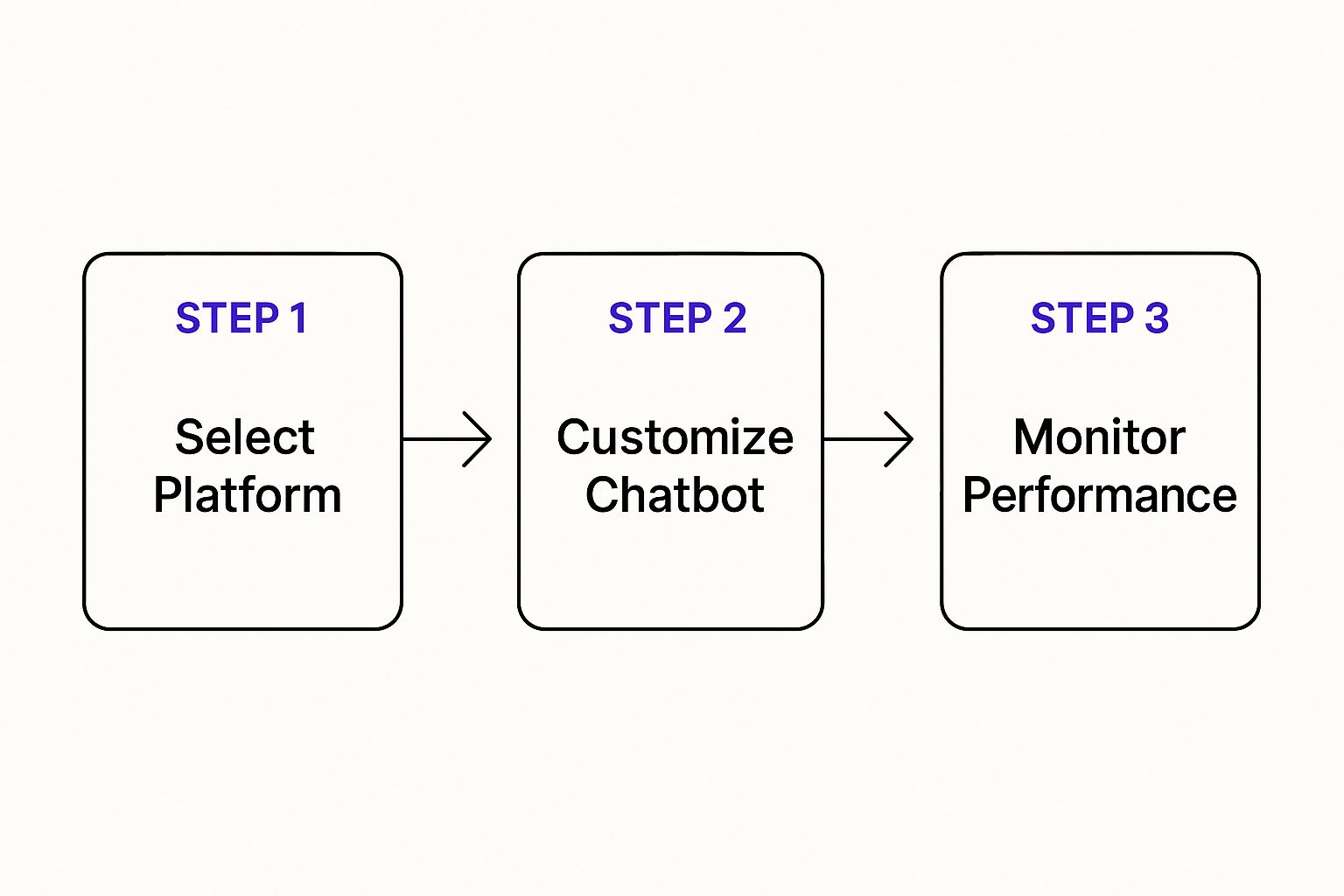
As you can see, implementation is a cycle, not a one-and-done task. Keeping an eye on performance is just as important as the initial setup.
Finally, give your chatbot a personality that fits your brand. A store that sells skateboards should sound very different from one selling luxury watches. Use your brand’s unique voice to craft everything from welcome messages and standard replies to error messages. This final touch makes the entire experience feel authentic and helps build a real connection with your customers, turning a simple tool into a true extension of your brand.
Best Practices for Optimizing Chatbot Performance
Launching your first chatbot for ecommerce is a fantastic start, but the real magic happens after it goes live. Think of it like tuning a high-performance engine; the initial build gets you on the road, but the ongoing adjustments are what help you win the race. Continuous optimization is what separates a decent chatbot from one that truly drives sales and delights customers.
Your chatbot isn't a "set it and forget it" tool. It’s a dynamic, learning machine that gets smarter with every conversation it has. Your job is to guide that learning by regularly checking its performance and making smart, data-driven tweaks. This ensures your bot keeps up with your customers' needs as they change over time.
One of the first things to get right is the handover to a human agent. Let's be realistic: no chatbot can answer every single question, and that's okay. The trick is to make the transition from bot to human completely seamless, so the customer never feels dropped or frustrated.
Perfecting the Human Handoff
A clunky handoff can ruin a customer's entire experience. The goal is to make them feel supported, not abandoned. When a chatbot realizes it's out of its depth, a simple "I can't help" just won't cut it.
Instead, a smooth handoff should look like this:
- Proactive Transfer: The bot should automatically route the conversation to an available agent without the customer having to ask.
- Full Context: The human agent must get the entire chat history. Nothing is more infuriating for a customer than having to repeat themselves.
- Clear Expectations: If an agent isn't free right away, the bot should tell the user how long the wait will be and maybe offer to create a support ticket for them.
This creates a safety net that builds serious trust. Customers learn that if the bot gets stuck, a capable human is ready to jump in without missing a beat. Getting this one process right can have a huge impact on your customer satisfaction scores.
Harness the Power of Personalization
Generic, one-size-fits-all responses feel cold and robotic. The best ecommerce chatbots use customer data to create interactions that feel genuinely helpful and personal. And I'm talking about more than just using someone's first name.
A truly optimized chatbot can:
- Reference past purchases: "I see you bought the Trailblazer hiking boots last month. Are you looking for waterproof socks to go with them?"
- Use browsing history: "You've been looking at our premium coffee grinders. Did you know the Model X is our top-rated for making espresso?"
- Offer tailored support: It can pull up an order history to give instant, specific updates on a shipment without even needing an order number.
Personalization transforms a simple Q&A tool into a sophisticated personal shopper. It shows the customer that you understand their needs, which is a powerful driver of both conversion and loyalty.
This level of detail makes the shopper feel seen and valued, creating a much stronger connection to your brand. It’s the digital version of that amazing store associate who actually remembers you.
Regularly Analyze and Refine Conversations
Your chatbot's chat logs are a goldmine of improvement data. Making it a regular habit to analyze these conversations is the secret to long-term success. By digging into this data, you can uncover priceless insights.
Look for these patterns in your chat history:
- Unanswered Questions: What are customers asking that your bot can't handle? This is a flashing sign telling you exactly what to add to your bot's knowledge base.
- Repetitive Queries: If hundreds of people are asking the same question, maybe that information needs to be clearer on your product pages or FAQ.
- Points of Frustration: Where do conversations go cold? Pinpointing where users get stuck or just give up shows you the exact friction points you need to smooth out.
Analyzing this information is fundamental. To really get into the weeds, you can explore specialized tools and techniques for improvement. We cover many of these in our guide to chatbot analytics, which will help you turn all that raw data into actionable strategies for a smarter, more effective bot.
The Future of AI Chatbots in Ecommerce
The world of conversational AI is moving at lightning speed. What seems futuristic today will be the baseline for customer expectations tomorrow. For any online business, keeping an eye on the horizon isn't just a good idea-it's essential for survival. The chatbot for ecommerce is rapidly evolving from a simple Q&A tool into a proactive, intelligent shopping companion that will redefine the online customer journey.
The next generation of innovation is focused on one thing: making chatbot interactions feel less like talking to a machine and more like a genuine conversation with an expert who actually gets it. We're moving away from rigid, pre-programmed scripts and into a new era where AI can anticipate what a customer needs, understand subtle language cues, and even show a bit of empathy. It's an exciting shift, with a few key trends leading the way.
The Dawn of Hyper-Personalization
The chatbots of tomorrow won't just sit around waiting to be asked a question. They'll start the conversation based on predictive insights. This is the heart of hyper-personalization, where an AI taps into a customer's real-time behavior, past purchases, and even on-site browsing habits to serve up incredibly relevant suggestions.
Think about it. A chatbot sees a customer looking back and forth between hiking boots and winter jackets. Instead of waiting for a prompt, it could proactively pop up and say, "Looks like you're gearing up for a cold-weather adventure! Based on the items you're checking out, you might want to see our new thermal base layers." This kind of proactive, smart assistance makes the shopping experience feel personal and curated, which dramatically increases the odds of making a sale.
The future of ecommerce chatbots isn't just about answering questions better; it's about asking the right questions before the customer even thinks of them. This shift from reactive to proactive engagement is where the real value lies.
Voice-Activated Shopping and Generative AI
The very way we use technology is changing, and voice commands are quickly becoming second nature. Soon, customers will expect to shop with their voice, asking their smart device to "find a blue, medium-sized t-shirt under $30" and having the store's chatbot guide them through the results without missing a beat. This hands-free, conversational shopping experience removes even more friction from the buying journey.
Powering this evolution is the explosion of generative AI, the same tech that makes tools like ChatGPT so impressive. For an ecommerce chatbot, this means it can grasp context, create much more human-like responses, and even pick up on a customer's emotional state, like frustration or excitement. If a customer sounds confused, the bot can soften its tone and offer a simpler explanation. As you explore more advanced functions, checking out something like Cometly's AI Chat feature can give you a real sense of what’s becoming possible.
When you combine these technologies, you start to see a future where your chatbot isn't just a feature on your site. It becomes a core part of your brand's personality-an empathetic, smart, and incredibly helpful guide for every shopper. Getting ready for this shift now will put your business in a prime position to meet the new standard of customer engagement.
Frequently Asked Questions About Ecommerce Chatbots
It's completely normal to have questions when you're thinking about bringing AI into your business. Even with all the potential upsides, you're probably wondering what an ecommerce chatbot really means for your sales, how much work is involved, and what the experience will be like for your customers. Let's get into some of the most common questions we hear from store owners just like you.
Getting clear, honest answers is the best way to move forward and find a solution that genuinely fits your brand and your goals.
Can a Chatbot Really Increase My Store's Sales?
Yes, absolutely. A well-trained chatbot is like having a top-tier sales associate working around the clock. It directly boosts revenue by tackling some of the biggest sales hurdles. For instance, it can catch shoppers just as they're about to leave their cart, offer them a timely discount to seal the deal, or suggest a perfect add-on product they might have missed.
It also clears up those last-minute doubts that stop a sale in its tracks. By giving instant answers to questions about shipping times, return policies, or product details, the chatbot builds trust and gives customers the confidence they need to complete their purchase. It’s a simple equation: faster help leads to higher conversion rates.
Think of it this way: a chatbot is your most reliable employee. It can juggle thousands of customer chats at once, making sure you never miss a sale-whether it's at 2 PM on a busy Tuesday or 2 AM on a holiday weekend.
Is It Difficult to Set Up a Chatbot on My Shopify Store?
Not anymore. The idea that you need a developer to get a chatbot running is a thing of the past. Today's platforms are built to be user-friendly, offering simple, no-code integrations for major ecommerce sites like Shopify, BigCommerce, and WooCommerce.
Getting started is usually a straightforward process:
- Connect Your Store: Just a few clicks to authorize the chatbot platform to sync with your shop.
- Add Your Data: Upload your product catalogs, link to your FAQ pages, and provide any other business documents. The AI learns from this material.
- Customize the Look: Tweak the colors, icon, and welcome message to make sure it feels like your brand.
- Go Live: Copy a small piece of code and paste it into your website’s theme.
Most tools come with ready-made ecommerce templates, which means you can have a surprisingly powerful bot up and running in minutes, not weeks.
Will a Chatbot Make My Customer Service Feel Impersonal?
This is a huge-and very valid-concern. The reality is, a modern AI chatbot can actually make your support feel more personal, not less. The secret is using it for what it's best at. A chatbot is brilliant at handling the simple, repetitive questions that flood your inbox, like "Where is my order?" or "What's your return policy?"
This instantly frees up your human support team. Instead of answering the same things over and over, they can focus their energy and empathy on the more complex or sensitive issues that truly need a human touch. A great chatbot also has a personality that reflects your brand and, critically, knows its own limitations. It's programmed to seamlessly hand a conversation over to a person whenever needed, so your customer never feels trapped or ignored.
Ready to see how a no-code AI assistant can transform your customer support and drive sales? At Whisperchat.ai, we make it simple to build a smart chatbot trained on your own business data. Get started in minutes and provide your customers with instant, 24/7 answers. Create your first chatbot today.