
Transform Your Business with Chatbots in Marketing
Learn how chatbots in marketing can boost engagement and ROI. Discover proven strategies to optimize your chatbot implementation today.
Not too long ago, using a chatbot in your marketing felt like a neat trick. Now, it's a core part of how smart businesses connect with customers around the clock. Think of them as your instant digital concierge, ready to have a real-time, personalized chat that helps people find exactly what they need.
This isn't just another marketing channel; it’s a complete shift away from the old-school method of blasting one-way messages out into the void. It’s about creating a genuine back-and-forth conversation.
The New Face of Customer Interaction
Let’s get one thing straight: chatbots aren't just annoying pop-ups anymore. They've grown up. We’ve moved past simple, pre-programmed scripts to sophisticated AI assistants that can actually understand what a person wants, figure out the context of the conversation, and deliver the right info on the spot.
This evolution represents a massive change in how we think about marketing. We're no longer just shouting messages at an audience. We're having meaningful conversations with them. In a world full of noise, that ability to create an instant, personal connection isn’t just a nice-to-have-it’s how you build real relationships and keep your edge.
From Static Forms to Dynamic Conversations
Remember the old days? A visitor lands on your site, and their only option is to fill out a static contact form and wait. And wait. Chatbots have completely flipped that script.
They meet customers right where they are-whether that’s on your website, a social media page, or inside a messaging app-with the perfect message at the perfect moment. This kind of immediate interaction keeps potential customers from drifting away and gives them a smooth, easy path to what they’re looking for. It’s the difference between leaving a message on an answering machine and having a helpful chat right then and there.
The Scale of Chatbot Adoption
The numbers don't lie; this isn't just a fleeting trend. The global chatbot market is exploding. It was valued at $2.47 billion back in 2021 and is on track to hit a staggering $15.57 billion by 2025.
What’s driving this? A huge demand for efficient, automated customer service and the fact that more than 987 million people are already using AI chatbots. If you're curious, you can explore more data on this trend to see the full picture.
To see how far we've come, just look at one of the earliest chatbots, ELIZA.
This early example shows the basic idea of a conversational back-and-forth. Today's chatbots in marketing are worlds away, using advanced AI to have natural, genuinely helpful conversations that actually move the needle for your business.
Why a Chatbot Strategy Is Non-Negotiable
It’s easy to talk about chatbots in abstract terms, but their real power hits you when you see them in action. This isn't about just bolting on another piece of software; it's about fundamentally rethinking how your business communicates, operates, and grows. It’s about turning those moments you used to miss into real, tangible wins.
Think about this: a potential customer lands on your website at 2 AM. They're in a different time zone, ready to learn or buy. Without a chatbot, they click around, can't find a quick answer, and leave. Poof. That lead is gone forever.
Now, imagine that same visitor is greeted instantly by a helpful bot. It answers their questions, captures their contact info, and qualifies them as a serious lead-all while your entire team is fast asleep. That’s 24/7 lead generation, and it’s a game-changer.
This is why a chatbot strategy isn't just a "nice-to-have" anymore. It's a core part of modern business, essential for staying efficient and keeping customers happy.

Driving Efficiency and Cost Savings
One of the first things you'll notice after implementing a chatbot is the impact on your operational costs. Just think about how many repetitive questions your support and sales teams field every single day. We're talking about the endless queries on shipping, pricing, or basic product features.
A well-configured chatbot can handle up to 80% of these routine inquiries on its own. The ripple effect across your organization is huge:
- Frees Up Your Team: Your people are no longer tied up with monotonous tasks. Instead, they can focus on complex customer problems that require a human touch.
- Boosts Productivity: With fewer interruptions, your team can dedicate their brainpower to closing big deals, nurturing client relationships, or working on strategic projects.
- Scales Instantly: When you get a huge spike in website traffic, the chatbot handles thousands of conversations at once without breaking a sweat. No need to scramble to hire more staff.
By taking over the common questions, businesses can see their customer service costs drop by as much as 30%. It’s not just about pinching pennies; it’s about reinvesting your team’s time and talent into activities that actually push the business forward.
Delivering Hyper-Personalization at Scale
Today's customers have high expectations. They want you to know what they need without them having to spell it out. A chatbot is the perfect tool for delivering this kind of personalized experience-at a scale no human team could ever manage.
Let’s say a visitor is browsing your e-commerce store. An AI-powered chatbot can watch their behavior in real-time-the pages they look at, the products they click on, and what they add to their cart. Armed with that data, it can jump in with helpful, tailored suggestions:
- Smart Product Recommendations: "I see you're checking out our running shoes. We just launched a new model specifically for trail running, would you like to see it?"
- Helpful Content: "Since you're looking at that hiking backpack, here’s our guide on how to choose the right one for your trip."
- Personalized Offers: "Hey, looks like you’ve got great taste! Complete your purchase today and I can give you 15% off everything in your cart."
This isn't just good service; it makes customers feel seen and understood, which is incredibly powerful for boosting engagement and sales. To get a fuller picture, you can dive into all the https://www.whisperchat.ai/blog/what-are-the-benefits-of-using-ai-chatbots in our detailed guide.
Remember, a chatbot isn't an isolated tool. It should be a key part of your effective digital marketing strategies to make sure everything works together smoothly. For any business that’s serious about being competitive and customer-focused, using chatbots in marketing is simply non-negotiable.
Putting Chatbots To Work Across The Funnel
Think of chatbots not just as a single tool, but as a strategic asset you can deploy across the entire marketing funnel. The conversation a customer needs when they first hear about you is completely different from the one they need when they're about to buy. A well-designed chatbot strategy recognizes this.
It's all about delivering the right conversation at the right moment. You wouldn't use the same script for a top-of-funnel visitor as you would for someone with a full shopping cart. Let's break down how to tailor your chatbot's role for each stage of the customer journey.
Capturing Attention In The Awareness Stage
At the top of the funnel, it's all about making a great first impression and starting a conversation. People are just discovering your brand, maybe from a social media ad or a Google search. A boring landing page with a static contact form isn't going to cut it; most people will just bounce.
This is where a chatbot can completely change the game. By putting a bot right on your landing page or even inside a paid ad, you can engage people instantly. Instead of forcing them to read a wall of text, the bot pulls them into a two-way dialogue.
- Interactive Ads: Imagine someone clicks your Facebook ad. Instead of just landing on a webpage, a Messenger bot immediately pops up asking, "Hey! Are you shopping for a gift or for yourself?" It’s a simple question, but it’s far more engaging than a passive page.
- Instant Lead Qualification: The bot can ask a few quick questions to figure out a visitor's needs or industry. This helps you route serious prospects to the right place while gathering valuable lead information from everyone else.
- Proactive Engagement: On your blog, a bot can appear with a helpful nudge, like, "Hi there! I see you're reading about our new feature. Want a quick 30-second tour?"
Nurturing Leads During Consideration
Okay, so they know who you are. Now they’re in the consideration stage, weighing their options and comparing you to the competition. Your chatbot’s job now shifts from a friendly greeter to a knowledgeable consultant.
In this middle stage, a bot acts as a 24/7 sales assistant. It can answer detailed product questions, offer personalized recommendations based on the user's answers, and guide people through a complex product catalog. You’re making sure no question goes unanswered and no potential lead goes cold just because it’s after hours.
For example, a chatbot on an ecommerce site can act like a personal shopper. It might ask about style, budget, and favorite colors, then instantly serve up a curated list of perfect products. This guided experience makes the decision process so much easier for the customer.
This image shows the key decisions you have to make when building out your chatbot strategy, from the tech you use to the channels you deploy it on.
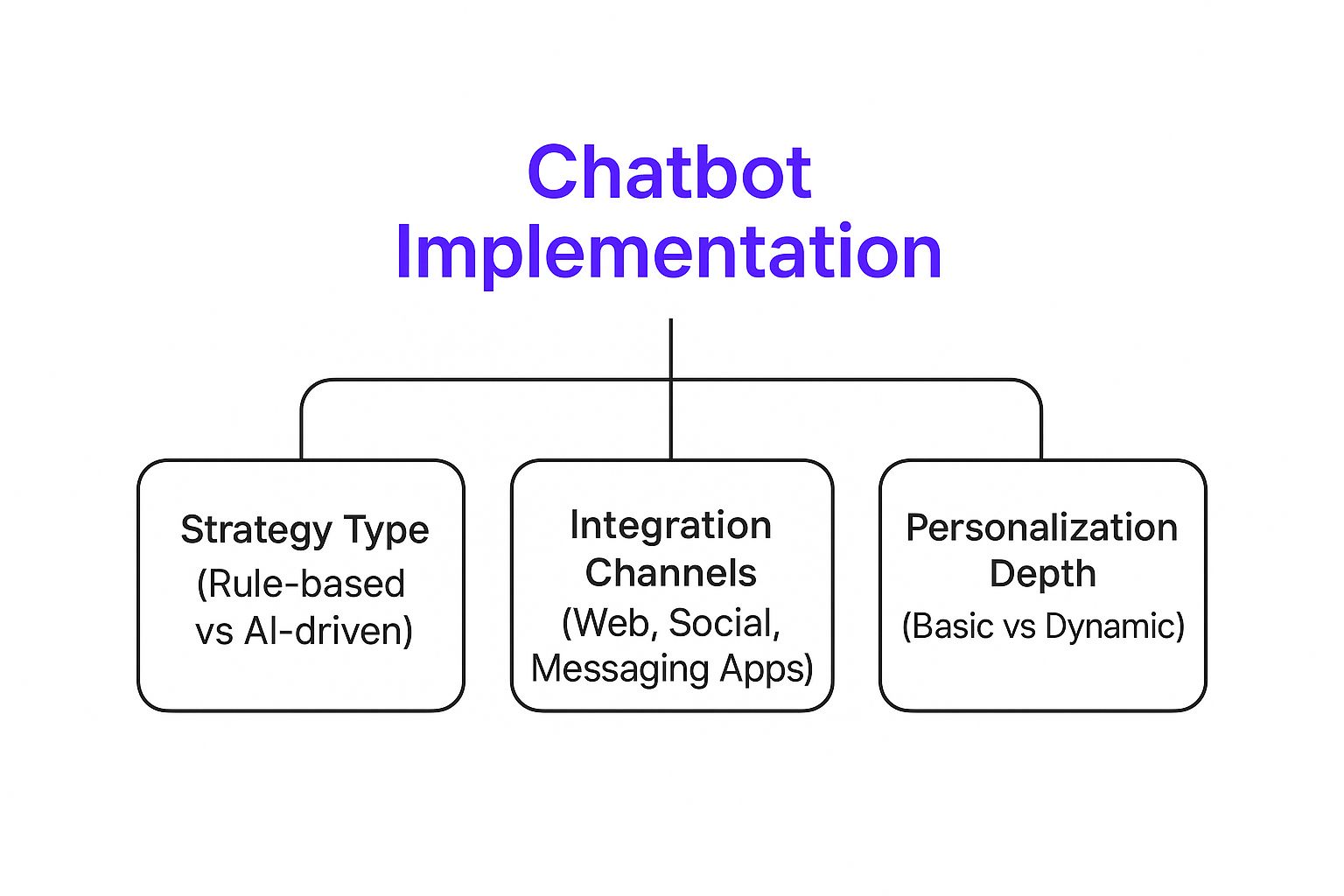
As you can see, a successful bot depends on getting the technology, placement, and level of personalization just right for your marketing goals.
To give you a clearer picture, this table breaks down how chatbots function at each point in the funnel.
Chatbot Use Cases by Marketing Funnel Stage
| Funnel Stage | Chatbot Objective | Example Use Case |
|---|---|---|
| Awareness | Grab attention & qualify leads | An interactive quiz in a social media ad that segments users. |
| Consideration | Educate & guide users | A bot on a pricing page that answers feature-specific questions. |
| Conversion | Remove friction & close the deal | An abandoned cart bot that offers a discount to complete the purchase. |
| Loyalty | Provide support & gather feedback | A post-purchase bot that helps customers track their orders. |
Each stage requires a different conversational approach, but when aligned, they create a seamless journey for the user.
Driving Action At The Conversion Stage
This is the moment of truth. Your prospect is right on the edge of buying, signing up, or booking that demo. The chatbot's job here is to knock down any last-minute barriers and make it ridiculously easy to say "yes."
One of the most effective tactics here is tackling abandoned carts. A bot can proactively message a user who left items behind, asking if they ran into trouble or had a question about shipping. Sometimes, a perfectly timed offer of 10% off is all it takes to seal the deal. For a deeper dive into these kinds of tactics, check out this guide on mastering conversion rate optimisation.
Fostering Loyalty After The Purchase
The sale isn't the end of the road-it's the beginning of a long-term relationship. The loyalty stage is all about turning that first-time buyer into a repeat customer and a vocal fan.
Post-purchase bots are fantastic for this. They can handle common support questions and collect priceless feedback without you lifting a finger.
- Order Tracking: A customer can just ask, "Where's my order?" and get an instant, real-time update. No need to hunt for a tracking number or call your support line.
- FAQ Automation: Bots can handle all the routine questions about returns, warranties, and product setup, which frees up your human support team to solve the really tough problems.
- Feedback Collection: A few days after an order is delivered, the bot can check in: "How are you liking your new gadget?" This is a simple, effective way to collect reviews and testimonials.
The financial impact here is huge and getting bigger. By 2025, it's estimated that e-commerce sales happening through chatbots will hit a massive $142 billion worldwide. Younger buyers are driving this trend, with 71% of Gen Z consumers already comfortable making purchases directly through chatbots. This isn't just a gimmick; it's a fundamental shift in how people want to shop.
Choosing the Right Chatbot Technology
Picking the right chatbot technology can feel a bit like choosing a car. Do you need a simple, reliable sedan to get you from A to B, or a high-performance sports car with all the bells and whistles? Both will get you there, but the experience and capabilities are completely different. The right choice for your marketing goals comes down to what you need, your budget, and how comfortable you are under the hood.
Not all chatbots are built the same. The tech powering them ranges from simple, flowchart-based systems to incredibly sophisticated artificial intelligence. Let's break down these options so you can find the perfect digital partner for your business.
Rule-Based Chatbots Explained
Think of a rule-based chatbot as an interactive phone menu or a very structured FAQ. It operates on a strict set of rules and a pre-defined conversation flow that you design. The bot offers users buttons and specific prompts, guiding them down a fixed path.
These bots are perfect for straightforward, predictable conversations. They don’t understand context or nuance; they just follow the script you give them.
- Best For: Simple lead qualification, answering basic questions like "What are your hours?", or routing visitors to the right department.
- Pros: They're cost-effective, easy to set up, and you have complete control over every possible conversation.
- Cons: They’re incredibly rigid. If a user asks something outside the script, the bot hits a wall and usually gives a generic "Sorry, I don't understand."
AI-Powered Chatbots Explained
AI-powered chatbots are the digital equivalent of a seasoned, knowledgeable salesperson. Instead of relying on rigid scripts, they use Natural Language Processing (NLP) to truly understand what a user is asking-typos, slang, and all. They learn from past interactions and get smarter over time.
These bots can juggle a huge range of questions, remember the context of a conversation, and provide much more human-like, personalized answers. This is how you create dynamic, engaging experiences that build real trust and drive conversions.
For example, an AI bot can understand the difference between "show me red running shoes" and "do you have any shoes for running in a red color?" A rule-based bot would likely get stuck on the second one, but an AI bot gets the user's intent.
This kind of advanced technology is catching on fast. Geographically, North America is leading the charge, holding between 31-37.5% of the global chatbot market share. This is thanks to strong tech infrastructure and the widespread adoption of powerful NLP. You can discover more insights on the global chatbot market to see how these trends are playing out.
Deciding Your Implementation Path
Once you’ve settled on rule-based vs. AI, the next question is how to actually build and launch it. There are three main routes you can take, each suited for different resources and technical skills.
No-Code Chatbot Builders: These platforms are made for the rest of us-the non-coders. Using a simple drag-and-drop interface, you can build, customize, and deploy a bot in minutes. Tools like Whisperchat.ai even let you train an AI bot on your own data (like your website or product docs), making setup unbelievably quick. This is the go-to choice for most small and medium-sized businesses.
Low-Code Platforms: This is the happy medium. These platforms give you pre-built templates and modules that you can tweak with some light coding. It’s a great fit if you have some development resources and need more customization than a no-code builder offers, but don't want to start from absolute scratch.
Custom Development: Building a chatbot from the ground up offers the ultimate control and flexibility. This is the path for large companies with very specific needs, complex software integrations, and a dedicated team of developers. It's also the most expensive and time-consuming option by a long shot.
Choosing the right tech is the bedrock of a successful chatbot marketing strategy. By taking a clear look at your goals, you can pick a solution that not only solves today's problems but can also grow with you tomorrow.
Getting Your First Marketing Chatbot Up and Running

Making the leap from theory to a live chatbot can feel like a huge step, but it’s less about knowing how to code and more about smart planning. Think of it like assembling a piece of furniture-if you follow the instructions step-by-step, you end up with something solid and useful. It's the same idea here.
The whole process kicks off with strategy, not technology. A chatbot without a clear purpose is just a fancy widget. Before you even think about what it will say, you need to decide what you want it to do.
Step 1: Define Your Primary Goal
First things first, pick one specific, measurable thing you want to accomplish. If you try to build a bot that does everything, you’ll end up with one that does nothing well. Zero in on a single, high-impact task.
Do you want to capture more leads? Cut down on repetitive support questions? Book more sales calls? Get specific. A great starting goal isn’t just "get more leads," but something like: "Increase qualified leads from our pricing page by 20% in the next 90 days." Now you have a clear target to aim for.
Step 2: Map the Conversation Flow
With your goal set, it's time to sketch out the conversation. This is your user's roadmap. You're guiding them from their first "hello" to a successful outcome, making sure they don't hit any dead ends. You don’t need any fancy software for this-a whiteboard or a simple document will do the trick.
Think through the key stages of the chat:
- The Opener: How will the bot start the conversation? A friendly, relevant greeting is key.
- The Questions: What information do you absolutely need to achieve your goal? Think name, email, or a key qualifying question.
- The User's Turn: What will people ask? What are their most common responses? Plan for a few different paths.
- The Finish Line: How does it all wrap up? This could be anything from confirming a meeting to passing the conversation to a live agent.
A logical flow is everything. A dead-end in a chatbot conversation is just as bad as a 404 error on a webpage. If you frustrate a user, you’ve lost them. For a more in-depth look at the technical side of this, check out our guide on https://www.whisperchat.ai/blog/how-to-implement-a-chatbot.
Step 3: Craft a Compelling Bot Persona
Your chatbot shouldn't sound like a machine. Giving it a personality that matches your brand makes the whole experience feel more natural and memorable. Is your brand voice fun and a little quirky, or is it more formal and straight to the point? That personality should come through in the bot's name, tone, and word choice.
This step might seem small, but it has a huge effect on how people perceive the interaction. A well-defined persona can turn a simple transaction into a positive brand moment. It's one piece of a much larger puzzle, and understanding the broader context of marketing automation implementation can help you see how it all fits together.
Fine-Tuning Your Chatbot for Peak Performance
Getting a chatbot live on your site is just the beginning. The real magic happens when you start refining it based on how real people actually use it. Think of your bot not as a "set it and forget it" tool, but as a living part of your team that gets smarter with a little coaching.
The best-performing bots are built on a solid foundation. You'd be surprised how small tweaks can transform a clunky, frustrating user experience into one that feels genuinely helpful and even delightful.
Set Clear Expectations from the First "Hello"
One of the fastest ways to annoy a visitor is to have your bot pretend it's a person. Don't do it. Be upfront from the very first message. Something as simple as, "Hi, I'm the AI assistant for [Your Brand Name]. How can I help you today?" immediately sets the right tone.
This bit of honesty works wonders. It stops people from typing in super complex questions the bot was never designed to answer. When they know they're talking to an AI, they naturally simplify their language, which leads to better, faster results for them and for you.
And always, always give them an out.
If a conversation goes off the rails or a user gets stuck, the gold standard is a smooth, one-click handoff to a human agent. This "escape hatch" is crucial for making sure a tricky bot interaction doesn't cost you a customer.
Write Copy That Actually Sounds Human
What your chatbot says is important, but how it says it is what truly defines the experience. Throw out the robotic, formal language. Your bot's voice should be an extension of your brand's personality-whether that's fun and witty or straightforward and professional.
Writing for a chatbot is a unique craft that's all about being clear and concise.
- Keep it short. No one wants to read a wall of text in a chat window. Break up information into bite-sized chunks.
- Guide the user. Use buttons and quick-reply options whenever you can. They make it easy for users to move the conversation forward without a lot of typing.
- Add some personality. A well-placed emoji or a friendly, conversational tone can make the entire interaction feel less like a transaction and more like a conversation.
If you're ready to really dig in and master this, checking out a comprehensive guide to chatbot best practices will give you the advanced strategies you need.
At the end of the day, a great chatbot feels less like a script and more like a helpful concierge. By setting clear expectations, writing compelling copy, and always having a human backup plan, you can turn your bot into a marketing powerhouse.
Common Questions About Marketing Chatbots
Diving into the world of marketing chatbots usually brings up a handful of important questions. Before you invest time and money, it’s only smart to get clear answers on the things that matter most. Figuring out the real costs, how a bot will affect your team, and how you’ll even know if it's working are all crucial steps.
Let's walk through the questions that are probably on your mind and get you the practical answers you need to move forward.
How Much Does a Marketing Chatbot Cost?
This is the big one, right? The cost of a marketing chatbot can range wildly-kind of like buying a car. You can find something for just about any budget, from a simple sedan to a custom-built sports car. It all boils down to the features and complexity you need.
- DIY No-Code Platforms: These are your most budget-friendly options, often running from $20 to $100 per month. Tools like Whisperchat.ai let you build a surprisingly powerful AI chatbot without writing a single line of code. They're a fantastic starting point for small and medium-sized businesses.
- Agency or Freelancer Builds: If you're looking for something more custom but don't want to hire a developer, this is a great middle ground. Expect a one-time setup cost between $1,000 and $5,000, plus some ongoing fees for maintenance.
- Custom Enterprise Solutions: For big companies with unique, complex demands, a fully custom chatbot is the way to go. This is a serious investment, often starting at $15,000 to $50,000 and going up from there, but it gives you complete control.
Will a Chatbot Replace My Team?
This is probably the most common fear I hear, but the reality is the complete opposite. A marketing chatbot isn’t coming for anyone's job; it’s here to make your team better at theirs. Think of it as the ultimate assistant-one that never sleeps and happily handles all the repetitive stuff.
A chatbot takes over the routine work-answering the same FAQs over and over, qualifying new leads, and being there for customers after hours. This frees up your actual people to focus on what they do best: building relationships, closing complex deals, and solving tricky problems that need a human touch. It's about making your team more powerful, not replacing them.
How Do I Measure Chatbot ROI?
Measuring the return on your chatbot investment is pretty straightforward once you know what to look for. The key is to connect its performance directly to your business goals.
Here are the main metrics you’ll want to track:
- Conversion Rate: Out of all the conversations, how many actually led to a good outcome, like a new lead or a sale?
- Cost Per Lead: How much are you paying the chatbot to generate one qualified lead? Compare this to your other marketing channels.
- Customer Satisfaction (CSAT): After a chat, just ask for a quick rating. It's the simplest way to see if people are having a good experience.
- Support Ticket Reduction: Are your human agents getting fewer of those basic, repetitive questions? Track the drop in support tickets.
By keeping an eye on these numbers, you’ll have a crystal-clear picture of the value your chatbot is delivering.
Ready to answer your customers' questions 24/7? With Whisperchat.ai, you can build and launch a custom AI chatbot in minutes, no coding required. Start your free trial today and see how easy it is to automate support and capture more leads.