
Reduce Call Center Costs a Smarter Way
Discover how to reduce call center costs without sacrificing service quality. Our guide covers AI, workforce optimization, and smarter process improvements.
The quickest path to a leaner call center budget isn't about making drastic cuts. It's about getting smarter with technology and fine-tuning your internal processes. The old playbook of reducing headcount is a fast track to frustrated customers and burned-out agents. Instead, modern call centers are boosting efficiency by using AI chatbots for the simple stuff, perfecting staffing schedules for busy times, and giving agents the tools they need to resolve issues in a flash.
The Real Challenge of High Call Center Costs

Every manager wants to rein in call center spending, but the knee-jerk reaction-slashing staff-almost always backfires. You end up with plummeting customer satisfaction and a revolving door of employees. The real balancing act is cutting expenses without compromising the customer experience.
This is where a more strategic mindset makes all the difference. Today’s top-performing contact centers don’t just cut costs; they optimize for value. They make smart investments that deliver significant savings down the road.
To help you get started, here's a quick look at the core strategies we'll be diving into.
Core Strategies for Smarter Cost Reduction
| Strategy Pillar | Primary Goal | Key Tools & Methods |
|---|---|---|
| Technology Adoption | Automate repetitive tasks to free up human agents for high-value work. | AI Chatbots & Voicebots, CRM Integrations, Self-Service Portals |
| Workforce Optimization | Align staffing levels precisely with customer demand to eliminate waste. | Workforce Management (WFM) Software, Call Volume Forecasting, Performance Analytics |
| Process Refinement | Empower agents to solve problems faster and more effectively on the first try. | Centralized Knowledge Bases, Ongoing Training, Streamlined Agent Workflows |
Each of these pillars represents a powerful opportunity to build a more efficient, effective, and ultimately, more profitable operation. Let's break them down.
Technology Adoption
This is all about putting AI to work on the high-volume, low-complexity interactions that clog up your phone lines. Think password resets, order status checks, and basic FAQs. By deploying chatbots and voicebots to handle these, you allow your human agents to focus on the complex problems that genuinely require their empathy and problem-solving skills.
Workforce Optimization
Let's be honest, labor is your biggest expense-often accounting for up to 70% of a call center's budget. Modern workforce management (WFM) software is a game-changer here. It helps you accurately predict call volumes so you can schedule the exact number of agents needed, avoiding the costly pitfalls of being overstaffed during lulls or understaffed during a rush.
Process Refinement
This is about setting your agents up for success. Give them a comprehensive, searchable knowledge base, invest in continuous training, and simplify their workflows. When agents have the answers at their fingertips, they can reduce handle times and dramatically improve first-call resolution rates. For a deeper dive, check out our guide on how to https://www.whisperchat.ai/blog/how-to-reduce-operational-costs.
Investing in your agents' tools and knowledge isn't just an expense; it's a direct path to greater efficiency and lower operational costs. By empowering them, you reduce agent turnover, which can cost anywhere from $18,500 to $74,000 per replacement.
Of course, another major strategy is outsourcing. For businesses looking to make a big impact on their bottom line, a comprehensive UK Customer Care Outsourcing Guide can be an invaluable resource, detailing the potential savings and operational advantages. This move can provide immediate access to a skilled talent pool and established infrastructure without the hefty overhead.
Let AI and Automation Handle the Routine Work
One of the fastest ways to slash call center costs is to let technology take over the simple, repetitive tasks that eat up your agents' day. This isn't about replacing your team. It's about freeing them up to focus on the complex, high-stakes problems where a human touch really matters.
Think about it. An AI chatbot can instantly handle the flood of "Where's my order?" questions during the holiday season. A voicebot can schedule appointments around the clock without ever needing a coffee break. These tools give customers immediate answers, which means fewer and fewer of those easy-to-solve calls ever need to reach a live agent.
The return on investment here is pretty clear. A retailer, for instance, could use a bot to manage the inevitable post-holiday return chaos. That move alone could save thousands in temporary staffing costs and keep customers happy with quick, no-wait service.
This chart breaks down how data and automation can create a more efficient, cost-effective workflow.
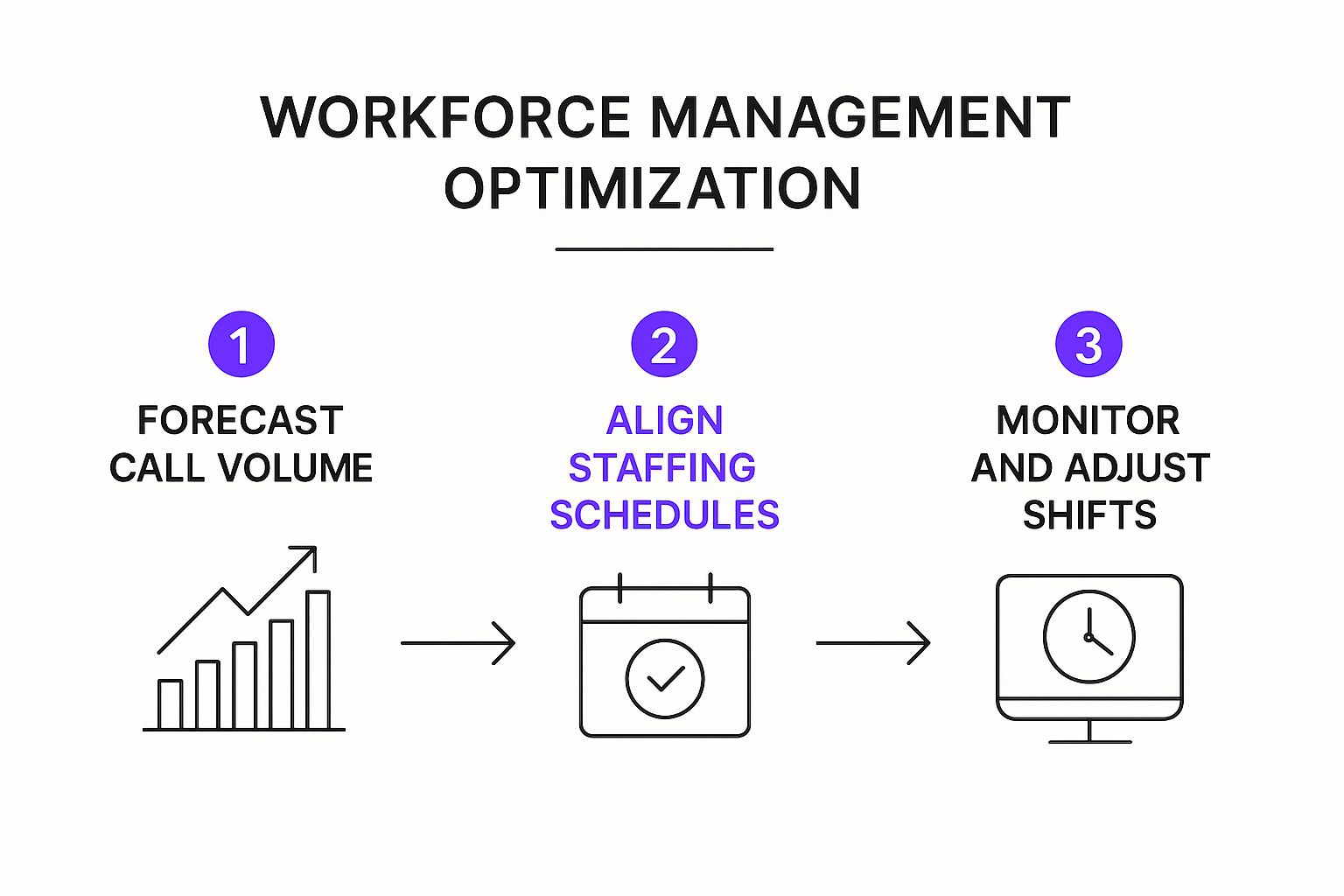
As you can see, forecasting call volume helps you build a smarter schedule. Then, by monitoring what's happening in real-time, you can constantly adjust and fine-tune, creating a super-efficient operational loop.
Pinpoint Your Problems with Analytics
It’s not just about chatbots. Tools like speech analytics are goldmines for finding hidden cost-saving opportunities. This tech scans call recordings to find out what's repeatedly frustrating your customers.
Let's say dozens of people call every week because a certain section of your billing statement is confusing. Analytics will spot that pattern immediately. Now you can fix the root cause-the confusing statement itself-and prevent those calls from ever happening again.
That's what proactive cost reduction looks like. You're not just handling calls faster; you're eliminating entire categories of calls from your queue for good.
Expert Tip: Don't automate for the sake of it. The best automation solves a specific, high-volume problem. Start by identifying the top 3-5 reasons people contact you, then figure out how a chatbot or an improved IVR could solve those issues without needing an agent.
The Real-World Impact of AI
The data backs this up. Bringing in AI-powered tools makes a huge difference.
- Speech analytics can lift customer satisfaction scores by up to 10% while cutting operational costs by 20-30%.
- AI chatbots can save a single agent around 2 hours and 20 minutes per day by taking over routine inquiries.
It's no wonder that global spending on conversational AI is projected to grow by 16% every year. If you want to seriously cut down on mundane questions and lower your overhead, it’s worth exploring effective strategies for customer support automation.
By putting these technologies to work, you're not just reducing your call center budget. You’re also building a faster, more responsive experience that customers will appreciate.
Optimizing Your Workforce with Smart Management

Once you’ve automated the easy stuff, the next place to find serious savings is in your biggest budget item: labor. When you need to reduce call center costs, getting your staffing levels just right isn't just a goal; it's a necessity. This is where modern Workforce Management (WFM) tools really shine.
Forget basic spreadsheets. Today’s WFM systems use predictive analytics to forecast your call volumes with incredible accuracy. This means you can finally nail down the exact number of agents you need online at any given time-no more, no less. You stop paying agents to sit idle during slow periods and avoid getting swamped when things unexpectedly heat up.
A Real-World Scenario
Picture a utility company preparing for a major storm. The old way of doing things was to overstaff the call center for 48 straight hours, resulting in huge overtime bills for agents who were just waiting by the phone most of the time.
With a good WFM system, that whole situation plays out differently.
- The software digs into historical data from past storms to see what really happens.
- It predicts that the call volume won't spike until 30 minutes after the storm is forecast to hit, not before.
- Based on that insight, the system builds an intelligent schedule that brings in more agents exactly when they’re needed and then scales back down as the call volume drops.
The result? The call center handles the emergency like a well-oiled machine without burning through cash on unnecessary payroll.
When you look at strategies to reduce call center costs on a global scale, optimizing your workforce is one of the most powerful moves you can make. It’s all about using smart forecasting to match your staffing to actual demand. Given that labor can eat up as much as 70% of a call center's budget, getting this right is a game-changer for your financial health. For a deeper dive, check out the insights on how workforce management cuts expenses on everhour.com.
The Hidden Costs of Agent Attrition
Smart workforce management is about more than just numbers on a schedule-it’s also one of your best tools for keeping your agents happy. High turnover is a quiet budget killer, costing thousands of dollars to replace a single agent when you factor in recruitment and training.
So, what causes agents to leave? Burnout is a huge one, often fueled by unfair schedules and imbalanced workloads. Nobody wants to feel constantly overworked or like they always get the worst shifts.
WFM systems tackle this head-on. They distribute tasks evenly and build schedules based on hard data and even agent preferences, taking the guesswork and bias out of the equation.
This helps you build a more stable, experienced team. And veteran agents are worth their weight in gold-they resolve issues faster, which directly improves your First Call Resolution (FCR) rates and makes customers happier. While this focuses on the human side, you can also lighten the load on your team by learning how to automate customer support for all those repetitive questions.
At the end of the day, investing in smart workforce management isn't just about fine-tuning schedules. It's about building a healthier, more sustainable operation that benefits everyone: your agents, your customers, and especially your bottom line.
Move to a Flexible Cloud-Based Call Center
If you’re still wrestling with on-premises hardware, you know the financial drain all too well. The constant maintenance, the big upfront costs, the physical space it all takes up-it’s a massive operational burden. One of the single most impactful things you can do to reduce call center costs is to finally cut the cord on those physical servers.
Switching to a cloud-based infrastructure is a game-changer. The old way meant sinking huge amounts of capital into hardware that would be outdated in a few years. Cloud solutions, on the other hand, operate on a predictable subscription model. This shift alone can slash your capital expenditure. For a closer look at the numbers, GoodCall offers a detailed cost breakdown that really highlights the financial difference.
What this really means is you're moving from a rigid capital expenditure (CapEx) model to a flexible operational expenditure (OpEx) model. Budgeting becomes simpler, and you can scale your spending to match your actual needs.
Embrace True Elasticity
Let’s get practical. Say you run an e-commerce business. Your call volume goes through the roof during the holiday season, maybe even tripling. With an old-school setup, you’d have to buy and maintain enough hardware to handle that peak load all year long. From January through October, most of that expensive equipment just sits there, collecting dust and depreciating.
A cloud contact center completely flips that script.
- Scale Up Instantly: When the holiday rush kicks off in November, you can add agent licenses and capacity with a few clicks.
- Scale Down Just as Fast: Come January, when things quiet down, you dial it all back just as easily.
- Pay Only for What You Use: You're only paying for that extra capacity for the two months you actually needed it.
This kind of elasticity is powerful. It stops the financial bleeding from over-provisioning and perfectly aligns your costs with your busiest, most profitable times of the year.
By adopting a pay-as-you-go model, you transform a fixed, often oversized cost into a variable expense that perfectly matches your business needs. This is the core financial advantage of the cloud.
Get More Value for Less Investment
The advantages don't stop at just scaling up and down. A huge part of any call center cost reduction plan is about getting more bang for your buck, and that’s where cloud platforms really shine.
Think about all the features that used to be expensive, complex add-ons for an on-premise system-things like advanced analytics, sophisticated Interactive Voice Response (IVR), or deep CRM integrations. With most cloud solutions, these powerful tools are built right in. Your team gets access to top-tier capabilities without the sky-high price tag or the IT nightmare of trying to make separate systems talk to each other. This doesn't just cut your direct costs; it makes your agents more effective, which means they can help customers better and faster.
Empower Your Agents by Refining Internal Processes
Putting money into automation and smarter scheduling is a great move, but tech alone can't fix every cost-related headache. The real secret often lies in your internal processes-the day-to-day workflows and tools your agents rely on. Helping your agents work smarter, not just harder, is one of the most direct ways to bring down call center expenses.
It all starts with giving them the right information, right when they need it. If your team is stuck using a clunky, slow system, they're forced to put customers on hold while they hunt for answers. That drives up call times, tanks customer satisfaction, and costs you money.
Build an Unbeatable Internal Knowledge Base
One of the single most impactful tools you can give your team is a rock-solid, easily searchable internal knowledge base. This becomes their go-to source for every policy, procedure, and troubleshooting guide. When an agent can pull up the right answer in a few seconds, you'll see an immediate, positive change in your most important cost-saving metrics.
Think about it: when an agent resolves a problem without having to flag down a supervisor or sift through old training docs, their Average Handle Time (AHT) drops significantly. It's been shown that even a 1% improvement in First Call Resolution (FCR) can cut operational costs by 1%, and a well-maintained knowledge base is the engine that makes high FCR possible.
Your knowledge base isn't just a digital filing cabinet; it's a strategic asset. Every second an agent saves looking for information is a second they can spend helping the next customer, which directly lowers your cost per call.
Here’s a real-world example: a software company kept getting calls about a tricky integration bug. Instead of letting each agent figure it out on their own, they created a detailed guide with screenshots and added it to the knowledge base. The next time a customer called with that issue, the agent found the guide instantly, walked the customer through the fix, and closed the ticket in less than half the time it used to take.
Prioritize Continuous Training and Development
Getting a new agent up to speed is crucial, but learning can't stop after their first few weeks. A "one-and-done" training approach leaves your team unprepared for new product features, updated policies, and the ever-changing needs of your customers. Continuous training is what turns a good agent into a truly great one.
And this doesn't have to mean pulling everyone off the floor for expensive, multi-day workshops. Effective, ongoing training can be much more nimble.
- Quick weekly huddles to review the most common or toughest issues from the past week.
- Self-paced online modules that agents can tackle during slower periods.
- Peer-to-peer coaching where you let your top performers share their tricks of the trade.
A well-trained team is a confident team. They resolve issues faster and escalate fewer calls. In a striking case, one major publisher managed to reduce call center operating costs by over 50%, saving more than $1 million per year, by simply doubling down on their coaching and training programs.
It just goes to show that investing in your people's skills delivers a massive return. At the end of the day, an empowered, knowledgeable team is your best defense against high operational costs and agent churn.
Got Questions? We've Got Answers
When you start digging into ways to cut call center costs, a lot of questions pop up. It’s natural. Let’s tackle some of the most common ones I hear from leaders trying to make their operations more efficient.
How Fast Can I Actually See Savings from AI?
This is the big one, right? The good news is, you can often see an impact much faster than you’d think. The trick is to not try and boil the ocean. Start with the easy wins-the high-volume, low-effort stuff.
For instance, if you set up a chatbot to handle all the "Where is my order?" questions, you can literally see your call volume drop right away. That’s a measurable dip in agent workload and costs you can probably spot within the first quarter. More complex projects, like using speech analytics to find out why people are calling in the first place, might take closer to six months to show major savings, because you have to actually fix the underlying problems.
A lot of people think implementing AI means a massive, year-long project. That's a myth. You can start small by training a chatbot on your existing FAQ page and start saving money in weeks, not years.
Does Bringing in Automation Mean Firing Agents?
This is a huge, and understandable, concern. But honestly, the goal is almost always to empower your agents, not replace them. Think about it: automation is perfect for the boring, repetitive questions that burn out your best people.
When you offload those simple tasks, you free up your human agents to handle the really tricky stuff-the issues that require real empathy, critical thinking, and complex problem-solving. This makes their jobs more interesting and valuable. Most companies I've worked with retrain those agents to become specialists in more complex areas, which actually boosts service quality and can reduce turnover. You’re just shifting your most valuable resource-your people-to where they can truly make a difference.
Is a Cloud-Based System Really Cheaper Over Time?
Absolutely, and the numbers don't lie. While there's an initial setup phase, the long-term financial upside is massive. On-premise systems are a constant drain on resources, with endless costs for hardware maintenance, software updates, server rooms, and the IT staff to manage it all.
A cloud system flips that model on its head. It turns a huge capital expense into a predictable operational one. You only pay for what you actually use, so you aren't over-provisioning for a holiday rush that only happens once a year. Plus, powerful features like advanced analytics and CRM integrations are often baked right in, saving you from buying expensive add-ons. Over time, the savings from reduced maintenance and increased agility almost always blow the subscription cost out of the water.
We Have a Tight Budget. Where Do We Even Begin?
You don't need a six-figure budget to get started. The smartest approach is to find your single biggest, most annoying pain point that’s also relatively easy to solve.
Here are a few low-cost ideas to get the ball rolling:
- Fix your internal knowledge base: This is a classic. Simply creating a well-organized, searchable resource for your agents is a cheap, high-impact project that immediately cuts down Average Handle Time.
- Launch a basic chatbot: Find a simple tool and train it to answer your top 10 most common questions. You'd be shocked at how many calls this can deflect.
- Clean up your IVR menu: Just making the options on your Interactive Voice Response system clearer can dramatically improve how calls are routed. Less frustration for customers means shorter, more efficient calls for you.
The key is to score a quick, demonstrable win. That success gives you the proof you need to get buy-in for bigger, more ambitious strategies to reduce call center costs.
Ready to slash support tickets and empower your team? Whisperchat.ai lets you build a powerful AI chatbot trained on your own data in minutes, no coding required. See how easy it is to automate routine questions and deliver instant answers 24/7. Start your free trial today.