
9 Key Advantages of Automated Customer Service for 2026
Discover the top advantages of automated customer service. Boost efficiency, cut costs, and improve CX with AI-driven support solutions like chatbots.
In a competitive market, customer expectations for instant, accurate, and accessible support are higher than ever. Meeting these demands with a purely human team is not only expensive but often impractical, especially as your business scales. This is where automated customer service, powered by AI-driven chatbots and intelligent systems, transforms from a "nice-to-have" feature into a core operational necessity. Implementing these tools is no longer about replacing human agents; it's about empowering them and creating a more efficient, responsive, and data-rich support ecosystem.
This article moves beyond the surface-level discussion to provide a detailed breakdown of the tangible advantages of automated customer service. We will explore how these systems deliver significant cost savings, provide 24/7 availability, and ensure a consistent brand voice across all interactions. You will discover how automation enhances scalability, improves employee satisfaction by handling repetitive queries, and captures valuable customer data to inform your business strategy. As businesses recognize the imperative for smart support, understanding the core advantages and implementation strategies becomes paramount. For a deeper dive into the top AI customer service benefits and strategies for the coming years, consider this comprehensive guide. Let's examine the key benefits that make automation a critical investment.
1. 24/7 Availability and Instant Response
One of the most significant advantages of automated customer service is its ability to operate around the clock, providing immediate support to users regardless of their location or the time of day. Unlike human-led teams constrained by business hours and staffing limitations, AI-driven systems are always on. This constant availability ensures that customers with urgent needs, such as a late-night password reset or a question about an order status, receive instant assistance instead of waiting for the next business day.
This immediate gratification is a cornerstone of the modern customer experience. By eliminating wait times for common inquiries, businesses can drastically reduce customer frustration and demonstrate a commitment to their needs. This level of responsiveness not only solves problems faster but also builds trust and loyalty, showing customers their time is valued.

How to Implement 24/7 Support
Successfully deploying an always-on automated system requires more than just turning on a chatbot. The goal is to provide genuine value at any hour.
- Implement Smart Handoffs: Design a clear escalation path. When the chatbot cannot resolve a complex issue, it should gracefully create a support ticket or inform the customer when a human agent will be available to follow up.
- Maintain a Dynamic Knowledge Base: Your AI is only as smart as the information it can access. Regularly update your knowledge base with new product details, policy changes, and answers to emerging customer questions to ensure its responses remain accurate and relevant.
- Analyze Off-Hours Traffic: Use analytics to identify the most common questions and issues that arise outside of standard business hours. This data can help you refine your chatbot’s responses and proactively address key customer pain points.
- Prioritize Mobile Optimization: Many customers will seek support from their mobile devices. Ensure your automated chat interface is fully responsive and easy to use on smaller screens for a seamless on-the-go experience.
2. Significant Cost Reduction
Another one of the core advantages of automated customer service is its profound impact on operational expenses. By handling a large volume of routine inquiries, automation significantly reduces the need for extensive human-led support teams. This leads to direct savings in salaries, benefits, training, and the physical infrastructure required to house a large call center, allowing businesses to reallocate critical resources to growth-focused areas.
This financial efficiency extends beyond just headcount. Automation minimizes the cost per interaction, as a single chatbot can manage thousands of conversations simultaneously at a fraction of the cost of a human agent. For instance, Bank of America’s chatbot, Erica, has managed millions of client requests, saving the company substantial operational costs. Similarly, KLM Royal Dutch Airlines uses automation to handle over 16,000 conversations weekly, streamlining service while keeping expenses low.
This bar chart illustrates the potential cost reduction benefits a business might see after implementing automated systems.
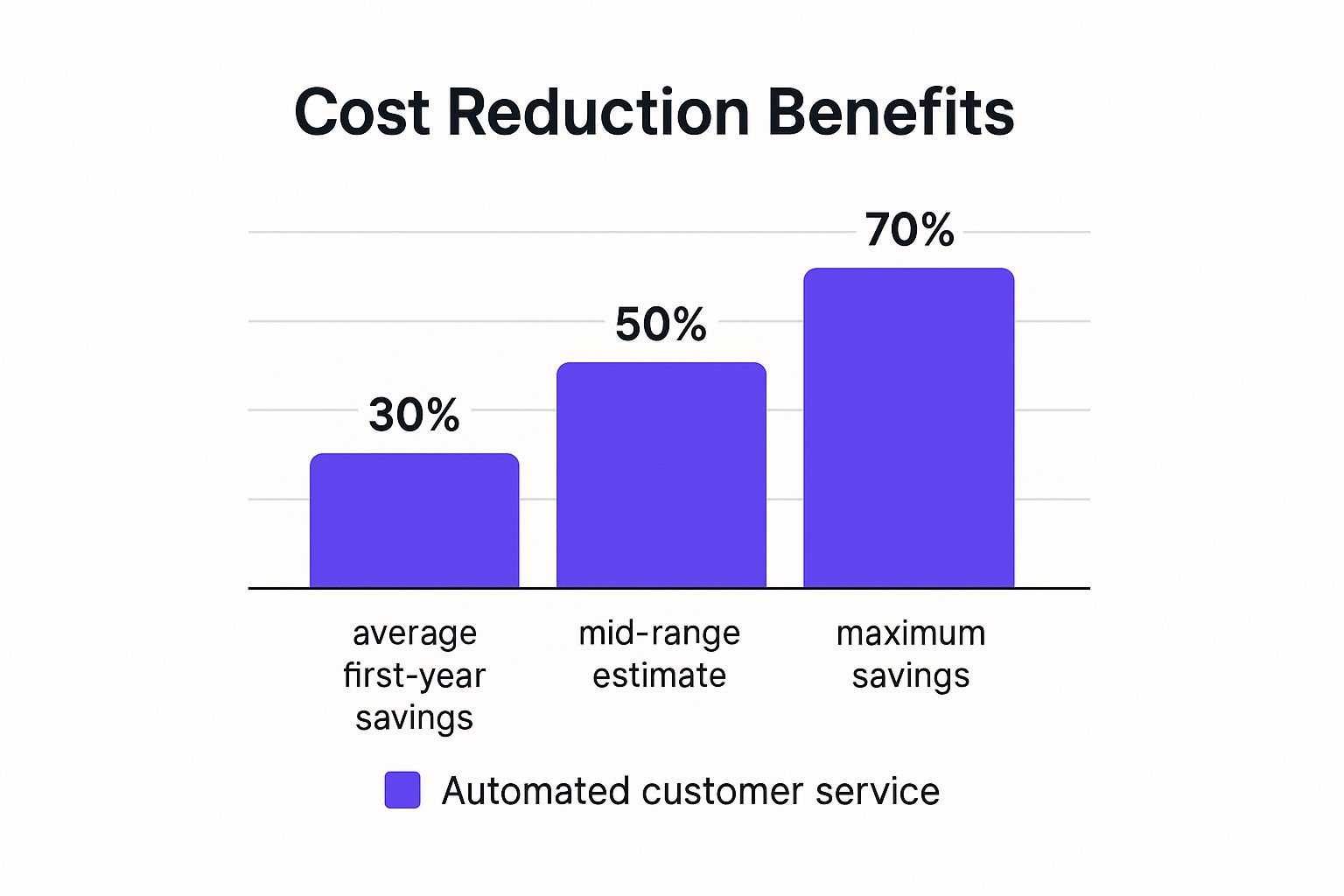
As the data shows, even a conservative implementation can yield significant savings, with potential reductions reaching up to 70% as automation matures and handles more complex tasks.
How to Maximize Cost Savings
Effectively reducing costs with automation requires a strategic approach focused on efficiency and return on investment. The goal is to lower expenses without sacrificing service quality.
- Start with High-Volume Inquiries: Identify the most frequent and repetitive customer questions, such as "Where is my order?" or "How do I reset my password?". Automating these first provides the quickest and most significant impact on reducing agent workload and operational costs.
- Calculate Total ROI: When evaluating automation, look beyond the initial setup price. Factor in long-term savings from reduced labor, lower training expenses, and increased agent productivity against the ongoing costs of software and maintenance. For a deeper dive, you can learn more about call center cost reduction on whisperchat.ai.
- Invest in Quality Automation: While cheaper solutions might seem appealing, a high-quality, intelligent automation platform like those offered by Zendesk or Salesforce reduces the need for constant fixes and manual oversight, lowering long-term maintenance costs and delivering a better customer experience.
- Monitor Cost Per Interaction: Regularly track metrics to measure the cost of resolving an issue through automation versus a human agent. This data will clearly demonstrate the financial benefits and help identify areas for further optimization.
3. Unlimited Scalability
One of the most powerful advantages of automated customer service is its inherent scalability. A human support team can only handle a finite number of inquiries at once, limited by headcount. In contrast, an AI-driven system can manage tens, thousands, or even millions of simultaneous customer interactions without any degradation in service quality or response time. This allows businesses to seamlessly manage sudden spikes in demand, such as during a product launch, a flash sale, or an unexpected service disruption, without needing to hire and train temporary staff.
This elasticity is a game-changer for growing businesses and enterprises with fluctuating query volumes. Companies like Netflix use automated systems to serve over 230 million subscribers, while Uber's support infrastructure scales effortlessly across more than 70 countries. This capability ensures every customer receives a consistent, high-quality experience, regardless of how busy the support channels become. It provides a level of operational agility that is impossible to achieve with human agents alone.

How to Implement for Scalability
Building a system that can handle unpredictable demand requires a forward-thinking approach to its architecture and maintenance. The goal is to ensure flawless performance during peak periods.
- Use Cloud Infrastructure: Leverage cloud platforms like Amazon Web Services (AWS) or Microsoft Azure. Their elastic infrastructure allows your system to automatically scale resources up or down based on real-time traffic, ensuring you only pay for what you use.
- Implement Load Balancing: Distribute incoming customer requests across multiple servers or instances. This prevents any single component from becoming a bottleneck, which maintains optimal performance and high availability even under extreme load.
- Design for Horizontal Scaling: Architect your system to scale horizontally, meaning you can add more machines to your resource pool. This is often more cost-effective and flexible than vertically scaling by upgrading to a more powerful single server.
- Monitor Performance Metrics: Continuously track key metrics like response time, concurrent user count, and error rates. Monitoring these indicators, especially during high-traffic events, helps you proactively identify and address potential performance issues before they impact customers.
4. Enhanced Consistency and Accuracy
A critical advantage of automated customer service is its ability to deliver perfectly consistent and accurate information with every interaction. Unlike human agents, whose performance can be affected by mood, training gaps, or simple error, automated systems follow programmed scripts and access a centralized knowledge base. This ensures every customer receives the same precise answer to the same question, every time.
This consistency eliminates the "agent roulette" that can frustrate customers, where one support representative provides a different answer than another. For instance, when a customer asks about a return policy or product specifications, an AI chatbot will provide the company's approved, official response, preventing misinformation. This level of reliability reinforces brand integrity and builds customer trust by ensuring the information they receive is always correct and standardized.
How to Ensure Consistency and Accuracy
Deploying an automated system is the first step, but maintaining its accuracy requires ongoing effort. The goal is to create a reliable single source of truth for your customers.
- Audit and Update Knowledge Bases: Regularly review and refresh the information your AI system uses. Set a schedule (e.g., quarterly) to audit your knowledge base for outdated policies, product details, or procedures to ensure all automated responses remain correct.
- Implement Version Control: Treat your automated responses like software code. Use version control for response templates and scripts so you can track changes, test new phrasing, and roll back to a previous version if an update introduces errors.
- Create Feedback Loops: Integrate a simple feedback mechanism (e.g., a thumbs-up/thumbs-down button) after an automated response. This allows users to flag incorrect or unhelpful answers, providing you with direct data to identify and correct errors quickly.
- Use A/B Testing for Clarity: Test different versions of a response to see which one resolves customer issues more effectively and with greater clarity. This data-driven approach helps you optimize for accuracy and user comprehension, not just correctness.
5. Comprehensive Data Collection and Analytics
One of the most powerful advantages of automated customer service is its capacity to act as an unparalleled data-gathering engine. Every interaction, from a simple query to a complex troubleshooting session, is automatically logged and structured. This creates a rich, real-time dataset that provides deep insights into customer behavior, common pain points, emerging trends, and overall service performance. Unlike manual data entry, this process is consistent and free from human error.
This treasure trove of information allows businesses to move beyond reactive support and make proactive, data-driven decisions. For instance, Starbucks' automated ordering system analyzes purchase patterns to offer personalized recommendations, while Tesla’s service system tracks vehicle data to predict maintenance needs. By systematically capturing every question and outcome, companies can identify gaps in their knowledge base, refine product features, and optimize the entire customer journey with precision.
How to Leverage Customer Interaction Data
Collecting data is only the first step; the real value comes from strategic analysis and application. Turning raw interaction logs into business intelligence requires a clear plan.
- Integrate Data with Your CRM: Connect your automated service platform to your Customer Relationship Management (CRM) system. This creates a holistic, 360-degree view of each customer, combining their support history with their purchase behavior and marketing interactions.
- Focus on Actionable Metrics: Avoid getting lost in vanity metrics like the total number of chats. Instead, concentrate on actionable KPIs such as resolution rate, escalation frequency, and common unresolved queries. These metrics pinpoint specific areas for improvement. You can learn more about how to track these key metrics by exploring chatbot analytics on whisperchat.ai.
- Use Data Visualization Tools: Raw data can be overwhelming. Employ tools like Tableau or Google Data Studio to create dashboards that visualize trends, patterns, and performance at a glance, making it easier for stakeholders to understand and act on the insights.
- Implement Robust Security and Privacy: Customer data is sensitive. Ensure you have strong data privacy protocols and security measures in place to protect user information and comply with regulations like GDPR and CCPA.
6. Seamless Multi-Channel Integration
A key advantage of automated customer service is its ability to create a cohesive and unified experience across every platform a customer might use. Modern customers expect to interact with businesses on their own terms, whether through a website chatbot, a mobile app, a social media message, or even a voice assistant. Automated systems can integrate these disparate channels, ensuring the conversation remains consistent and context-aware no matter where it starts or continues.
This seamless integration eliminates the frustrating experience of having to repeat information when switching from one channel to another. A customer can start a query on Facebook Messenger, continue it on the company’s website, and receive a follow-up email without losing any progress. This creates a single, persistent customer profile and conversation history, making interactions smoother and more efficient for both the customer and the business.
How to Implement Multi-Channel Integration
Building a truly integrated support system requires a strategic approach that connects technology with customer behavior. The goal is to make channel-switching invisible to the user.
- Prioritize Key Channels: Use analytics to identify where your customers spend most of their time. Focus your initial integration efforts on the channels with the highest engagement, such as your website, mobile app, or primary social media platforms.
- Centralize Customer Data: Implement a robust customer data platform (CDP) or CRM that can act as a single source of truth. All automated interactions, regardless of the channel, should feed into this central hub to build a complete customer profile.
- Ensure Consistent Branding: The tone, voice, and visual identity of your automated assistant must be consistent across all platforms. This reinforces brand trust and ensures a familiar, reliable experience for the user.
- Test Integration Points Rigorously: Regularly test the handoff process between different channels. For example, check if a conversation started on a web chatbot can be seamlessly picked up within the mobile app without requiring the user to start over.
7. Improved Employee Productivity and Satisfaction
One of the most transformative advantages of automated customer service is its positive impact on your human support team. By handling the high volume of routine, repetitive inquiries, automation frees up your agents to concentrate on more complex, high-value interactions that require empathy, critical thinking, and nuanced problem-solving. This shift allows employees to move from being reactive ticket-solvers to proactive relationship-builders.
This strategic division of labor not only boosts overall team productivity but also significantly enhances job satisfaction. When agents are no longer bogged down by monotonous tasks like password resets or order status updates, they can engage in more meaningful work. For example, Zappos automates basic tracking inquiries, enabling its agents to focus on creating memorable customer experiences and building brand loyalty, a core tenet of their business model.
How to Enhance Agent Performance with Automation
Implementing automation to support your team requires a thoughtful, human-centric approach. The goal is to augment your agents, not replace them.
- Involve Employees in Design: Include your support agents in the process of designing and implementing the automated system. They have firsthand knowledge of common customer pain points and can provide invaluable insights into which queries are best suited for automation.
- Focus on Upskilling and Training: As automation takes over routine tasks, invest in training programs to upskill your agents. Focus on developing their skills in complex problem-solving, negotiation, and emotional intelligence, preparing them for higher-value responsibilities.
- Establish Clear Escalation Paths: Ensure there is a seamless and clearly defined process for the automated system to hand off a conversation to a human agent. This prevents customer frustration and empowers agents to step in precisely when their expertise is needed most.
- Promote a Collaborative Environment: Frame automation as a tool that assists the team, much like the systems offered by pioneers like Freshworks. This fosters a collaborative environment where agents see AI as a supportive partner that helps them perform their jobs more effectively.
8. Enhanced Customer Experience and Satisfaction
Ultimately, the goal of any customer service initiative is to improve the overall customer experience, and this is one of the most compelling advantages of automated customer service. By providing faster resolutions, personalized interactions, and proactive support, automation directly contributes to higher satisfaction scores. When customers receive quick, accurate answers and feel understood, their perception of the brand improves significantly.
This enhancement goes beyond just speed. Automation ensures a consistent quality of service that is difficult to achieve with human teams alone. Whether a customer interacts with the system at 3 AM or during peak business hours, they receive the same level of support. This reliability builds trust and fosters loyalty, turning one-time buyers into repeat customers. For instance, Amazon's proactive shipping notifications and Spotify's personalized playlists are prime examples of automation enhancing the experience without direct human interaction.
How to Improve the Customer Experience with Automation
Deploying automation to boost satisfaction requires a strategic, customer-centric approach. The key is to blend efficiency with a genuinely helpful user journey.
- Balance Automation with a Human Touch: While automation is powerful, it shouldn't be a wall. Always provide a clear and easy path for customers to connect with a human agent when their issue is complex or they simply prefer it.
- Collect and Analyze Customer Feedback: Actively solicit feedback on your automated interactions. Use surveys, ratings, and sentiment analysis to understand what's working and where improvements are needed.
- Continuously Optimize Based on Behavior: Analyze how customers interact with your automated systems. Identify common drop-off points or frequently misunderstood questions to refine scripts and improve resolution rates. You can learn more about how to refine your strategy by exploring different approaches to customer support automation.
- Implement Proactive Support: Don't wait for customers to come to you. Use automation to send proactive messages, such as order status updates, appointment reminders, or helpful tips related to their recent purchase.
9. Reduced Employee Turnover and Improved Agent Morale
A often-overlooked advantage of automated customer service is its profound impact on human support agents. By automating repetitive, low-level inquiries, businesses can significantly reduce agent burnout and increase job satisfaction. When AI handles the mundane tasks like password resets, order tracking, and basic FAQs, human agents are freed to focus on more complex, high-value, and emotionally nuanced customer issues that require critical thinking and empathy.
This strategic division of labor transforms the role of a customer service agent from a monotonous task handler to a specialized problem-solver. This shift not only makes the job more engaging and rewarding but also creates clear career progression paths. As a result, companies experience lower employee turnover rates, reducing the significant costs associated with recruiting, hiring, and training new staff. A happier, more experienced support team directly translates to a higher quality of customer care.

How to Boost Agent Morale with Automation
Implementing automation to support your human team requires a thoughtful, agent-centric approach. The goal is to empower them, not replace them.
- Define Clear Roles for AI and Humans: Create a clear distinction between what the chatbot handles and what gets escalated. Communicate this strategy to your team so they understand how the AI helps them focus on more fulfilling work.
- Invest in Upskilling and Training: Use the time saved by automation to invest in your agents. Provide training on advanced product knowledge, de-escalation techniques, and complex problem-solving to help them handle sophisticated issues effectively.
- Use AI as an Agent-Assist Tool: Implement AI tools that work alongside your agents during live chats. These tools can suggest answers, pull up customer history, and find knowledge base articles in real-time, helping agents resolve issues faster and with less stress.
- Solicit Agent Feedback: Regularly ask your support team for feedback on the chatbot’s performance. They are on the front lines and can provide invaluable insights into what’s working, what’s not, and where the automation can be improved to better assist them.
Advantages Comparison Matrix of 9 Automated Customer Service Features
| Feature / Aspect | 24/7 Availability and Instant Response | Significant Cost Reduction | Unlimited Scalability | Enhanced Consistency and Accuracy | Comprehensive Data Collection and Analytics | Seamless Multi-Channel Integration | Improved Employee Productivity and Satisfaction | Enhanced Customer Experience and Satisfaction |
|---|---|---|---|---|---|---|---|---|
| Implementation Complexity | Moderate - requires continuous uptime and AI training | High - initial setup costly but scalable | High - needs robust infrastructure and cloud integration | Moderate - requires accurate programming and audits | High - involves data systems and analytics expertise | High - complex integrations across multiple platforms | Moderate - requires change management and training | Moderate - balancing automation with human touch points |
| Resource Requirements | Reliable AI systems and 24/7 infrastructure | Investment in automation tools and maintenance | Scalable cloud infrastructure and load balancing | Well-maintained knowledge bases and version control tools | Data storage, analytics tools, and privacy measures | Integration platforms and customer identification systems | Training, monitoring tools, and agent support systems | AI tools, feedback systems, and escalation protocols |
| Expected Outcomes | Immediate, consistent customer support anytime | Significant reduction of operational costs (30-70%) | Ability to handle unlimited simultaneous interactions | Uniform, accurate responses reducing errors | In-depth insights on customer behavior and preferences | Unified, seamless customer interactions across channels | Increased agent productivity (40-60%) and job satisfaction | Faster resolutions, personalized service, and higher loyalty |
| Ideal Use Cases | Global businesses needing round-the-clock customer support | Cost-sensitive organizations aiming to optimize expenses | Businesses with fluctuating or growing customer demand | Companies prioritizing brand consistency and accuracy | Enterprises focusing on data-driven decisions and feedback | Organizations with diverse customer touchpoints | Call centers aiming to reduce burnout and improve skills | Customer-centric companies wanting improved satisfaction |
| Key Advantages | Eliminates wait times, supports multi-timezone customers | Predictable expenses, resource reallocation | No queue limits, supports viral or seasonal spikes | Eliminates human error, enforces policies consistently | Enables predictive analytics and personalization | Enhances brand cohesion and reduces customer effort | Frees agents for complex tasks, reduces burnout | Improves NPS and customer loyalty through personalization |
| Notable Challenges | Lacks human empathy, possible downtime impact | High initial cost, ongoing maintenance | Requires technical robustness, complex issues need human | May lack personalization, risk of systematic errors | Privacy concerns, requires advanced analytics skills | Technical complexity and higher setup costs | Employee resistance, potential job displacement | Risk of over-automation, possible frustration with limits |
Your Next Move: Embracing the Future of Customer Service
The journey through the core advantages of automated customer service reveals a clear and compelling narrative: automation is no longer a futuristic concept but a foundational element of modern business strategy. We've explored how implementing AI-driven solutions like chatbots can revolutionize operations, moving far beyond simple cost-cutting measures. The benefits stack up to create a powerful engine for growth, efficiency, and customer loyalty.
From providing 24/7 instant responses that meet the demands of today's always-on consumer to offering unlimited scalability during peak seasons without a proportional increase in overhead, the operational arguments are undeniable. These systems eliminate the financial and logistical barriers that once prevented small and medium-sized businesses from competing with enterprise-level support infrastructure.
However, the true power lies in the strategic synthesis of these benefits.
From Tactical Gains to Strategic Transformation
The real takeaway is not just about isolated improvements. It's about how these advantages interconnect to create a new paradigm for customer interaction.
- Data as a Compass: The comprehensive data collection capabilities of automated systems do more than just track metrics. They provide a direct, unfiltered view into your customers' minds, revealing pain points, product interests, and service gaps. This insight fuels smarter marketing, better product development, and more personalized experiences.
- Empowering Your Human Talent: By automating repetitive, first-tier inquiries, you liberate your human agents. This shift allows them to focus on high-value, complex problem-solving and proactive customer relationship-building. The result is not just improved employee productivity but also higher job satisfaction and lower turnover, strengthening the very core of your support team.
- A Unified Customer Journey: Seamless multi-channel integration ensures that whether a customer interacts with you on your website, a social media platform, or a messaging app, their experience is consistent, accurate, and context-aware. This reliability builds trust and fosters a sense of effortless engagement that defines an enhanced customer experience.
Ultimately, mastering automated customer service is about future-proofing your business. It’s a strategic move to build a more resilient, intelligent, and customer-centric operation. The initial step is to identify the most significant friction point in your current support process, whether it’s slow response times, high support costs, or missed lead opportunities. Start there. A small, well-defined pilot project can deliver measurable results and build momentum for broader implementation. The advantages are clear, the technology is accessible, and the time to act is now.
Ready to unlock these advantages for your own business? See how Whisperchat.ai makes it simple to deploy a sophisticated AI chatbot on your website in minutes, no coding required. Start converting visitors, delighting customers, and scaling your support today by exploring our powerful, easy-to-use platform at Whisperchat.ai.